
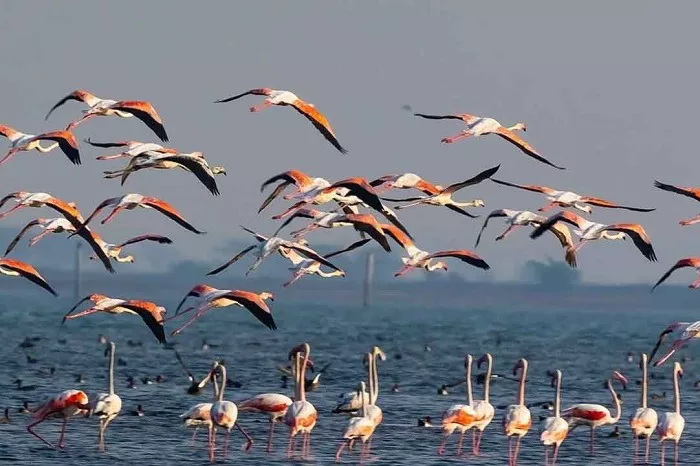
Sambalpur: The annual Mid-Winter Waterfowl Census at Hirakud Reservoir in Odisha’s Sambalpur district has recorded a significant increase in bird numbers this year, highlighting the region’s growing importance as a habitat for migratory and resident birds.
According to Divisional Forest Officer (DFO) Anshu Pragyan Das of the Hirakud Wildlife Division, the census—concluded on January 18—counted 4.21 lakh birds from 128 species. This marks a clear rise compared to last year’s count of 3.77 lakh birds across 122 species.
The day-long census was conducted from 6 am to 6 pm and covered the reservoir, surrounding wetlands, and the power channel over an area of 5.72 square kilometres, stretching from Hirakud Dam to the Odisha–Chhattisgarh border. During the survey, five bird species were recorded for the first time: Ruddy Crake, Greater Painted Snipe, Painted Stork, Little Gull, and Sanderling.
A wide variety of waterfowl and waders were observed, including Tufted Ducks, Lesser Whistling Ducks, Grebes, Bar-headed Geese, Brahminy Ducks, Gadwalls, Eurasian Wigeons, Northern Pintails, Northern Shovelers, Red-crested Pochards, Sandpipers, gulls, terns, pratincoles, kingfishers, Indian Skimmers, cormorants, egrets, herons, and plovers.
Among all species counted, Tufted Duck emerged as the most numerous with 71,273 birds, followed by Lesser Whistling Duck (60,987) and Common Coot (51,665). The highest concentration of birds was recorded in sectors 7, 8, and 9, located upstream near the Odisha–Chhattisgarh border.
Experts attributed the rise in bird numbers to favourable ecological conditions, including submerged islands, healthy aquatic vegetation, abundant food sources, suitable sandbars for nesting and wintering, and reduced fishing activity in key areas.
The census was conducted across 21 designated sectors by 38 teams involving 93 participants. Each team was led by an experienced birder and supported by forest personnel from Sambalpur, Jharsuguda, and Bargarh districts. To ensure accurate counting and avoid overlap, teams were provided with KML mapping files. Birding experts from Sambalpur’s Chadhei Club, as well as from Jharsuguda, Bolangir, Sonepur, and Bargarh, played a major role in the exercise, along with participants from Bhubaneswar, Cuttack, and other coastal districts.
 Facebook
  Instagram
  Youtube
 Spanish
  English