
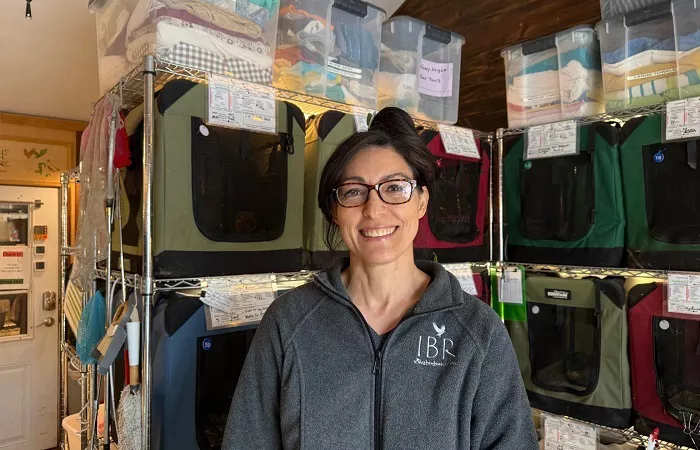
Iowa Bird Rehabilitation, a nonprofit organization based in Des Moines, cares for thousands of wild birds every year, giving them a second chance at life. As the nonprofit approaches capacity, its founder, Jenni Boonjakuakul, has big plans to build the state’s first wild bird hospital and education center.
Saving Birds, One Recovery at a Time
On a recent visit, nearly a dozen American White Pelicans crowded around their enclosure as employee Carter Whalen tossed handfuls of small fish into water-filled tubs. The pelicans eagerly scooped up several fish at a time with their long bill pouches. These pelicans, like many other birds at Iowa Bird Rehabilitation, arrived at the nonprofit after suffering from broken wings and other injuries. The organization’s mission is simple: help these birds recover and return them to the wild.
“Pretty much anything with feathers that flies through Iowa, we can admit,” says Boonjakuakul, who founded the nonprofit.
What sets Iowa Bird Rehabilitation apart is its extensive experience and rare permits. The nonprofit holds state and federal certifications to care for a wide range of birds, from tiny hummingbirds to Trumpeter Swans, North America’s heaviest flying bird.
In 2024, Iowa Bird Rehabilitation cared for nearly 3,200 birds representing 117 species. Boonjakuakul expects the number of birds admitted in 2025 will be similar or even higher.
A Growing Need for More Space
Iowa Bird Rehabilitation relies heavily on volunteers to care for the birds. During the busiest months, from April to September, up to 80 volunteers help with everything from rescues to feeding baby birds. But despite these efforts, the nonprofit is nearing capacity.
“I’m doing everything I can with the space I have,” Boonjakuakul says, noting that the organization is outgrowing its current setup. The birds are cared for in various outbuildings at Boonjakuakul’s home in a residential neighborhood, but the organization can’t keep up with the demand.
The next step? Building Iowa’s first wild bird hospital and education center. This facility will provide more space for medical care, rehabilitation, and even community education about the importance of birds in the ecosystem.
A Personal Journey to Bird Rehabilitation
Boonjakuakul’s passion for bird rehabilitation began as a graduate student in California. She took in a baby crow, which ultimately imprinted on her and couldn’t be released back into the wild. This experience sparked her desire to learn how to rehabilitate wild birds properly.
After moving to Iowa with her husband, Boonjakuakul trained in bird rehabilitation and obtained the necessary permits. In 2012, she started caring for 170 birds in the basement of her home while working full-time. The nonprofit officially launched in 2018, and by 2021, Boonjakuakul had left her full-time job to focus on Iowa Bird Rehabilitation full-time.
Expanding for the Future
Iowa Bird Rehabilitation’s current space is a “Band-Aid solution,” according to Boonjakuakul. The center is in the process of adding a new kitchen and more space for medical care and isolation. However, Boonjakuakul knows that a larger facility is needed to keep up with the growing demand for services. The dream is to create a hospital and education center on five acres of land in the Des Moines area.
With the new facility, Boonjakuakul hopes to hire a full-time veterinarian and technician to provide the best possible care for injured birds. The center would also have a pool for waterfowl and both indoor and outdoor flight cages to help birds recover and prepare for release.
In addition to rehabilitation, the nonprofit aims to raise awareness about avian conservation. The proposed education center will provide a space for training, community events, and efforts to educate the public on the importance of birds and the challenges they face.
The Need for Bird Conservation
Over the past 50 years, researchers estimate that North America has lost nearly 3 billion birds, or 29% of its bird population. This decline is largely due to habitat loss and other environmental factors. Boonjakuakul believes that bird conservation is critical, not just for the birds themselves but for the broader ecosystem.
“Birds play a vital role in controlling pests, pollinating plants, and spreading seeds,” she says. “If we lose birds, it could directly impact humans in the future.”
Joel Sartore, a National Geographic Explorer and photographer, recently visited Iowa Bird Rehabilitation. He praised the nonprofit’s efforts and highlighted the importance of supporting organizations like Iowa Bird Rehabilitation to help protect birds and other wildlife.
“We really need to shape up and save habitats if we want to survive ourselves,” Sartore said.
 Facebook
  Instagram
  Youtube
 Spanish
  English