
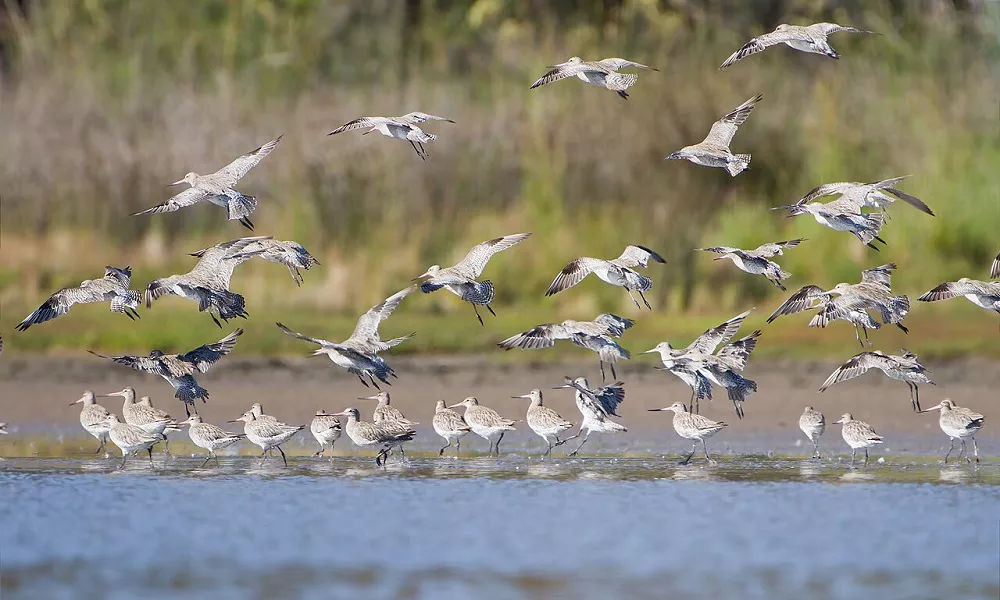
Gandhinagar, Jan 4 (IANS): Gujarat’s wetlands recorded more than 8.33 lakh birds during the 2024–25 season, reinforcing the state’s reputation as one of India’s safest and most preferred destinations for migratory and resident birds.
Official data show that Khijadiya Bird Sanctuary alone hosted over 3.09 lakh birds from 334 species in the past year. Nal Sarovar and Thol Bird Sanctuaries together recorded more than 4.67 lakh birds, while Wadhwana Wetland reported over 54,000 birds.
The Kutch region also saw significant avian activity, with 2,564 migratory birds recorded in 2025, highlighting its growing importance along international migratory routes. Globally, around 9,000 bird species are known, of which nearly 1,200 are found in India, including over 400 migratory species. Many of these birds travel thousands of kilometres from regions such as Siberia, Eastern Europe, North Asia and Central Asia to spend the winter in Gujarat’s wetlands.
Officials credit the steady rise in bird numbers to Gujarat’s long-standing conservation policies. Wildlife protection efforts initiated during Prime Minister Narendra Modi’s tenure as Gujarat Chief Minister have continued under Chief Minister Bhupendra Patel, with a focus on strict enforcement, habitat protection and community involvement.
Under the guidance of Forest and Environment Minister Arjun Modhwadia and Minister of State Pravin Mali, the Forest Department and wildlife organisations have carried out sustained conservation and habitat management initiatives. At Khijadiya, commonly sighted species included flamingos, pelicans, painted storks, ibises, spoonbills, ducks, geese, eagles, kites, kingfishers and herons.
According to the 2023 population estimate, Gujarat is also home to more than 2.85 lakh peafowl, India’s national bird.
Nal Sarovar, declared a bird sanctuary in 1969 and recognised as a Ramsar Site in 2012, covers 120.82 square kilometres and lies along the Central Asian Flyway. It has recorded 329 bird species, including passage migrants that stop briefly during long-distance journeys.
Thol Bird Sanctuary continues to attract a wide variety of waterbirds such as pelicans, ducks, geese, cranes, ibises, storks, raptors and waders. Wadhwana Wetland has reported migratory species including bar-headed geese, northern pintails, common teal, glossy ibises and the rare black-necked stork.
Kutch has gained renewed attention through the Passage Migrant Count, India’s flagship citizen-science initiative launched in 2022. The fourth and largest edition of the survey was conducted from September 19 to 21 across 10,000 square kilometres of the region. More than 200 birdwatchers from 17 states surveyed deserts, grasslands, thorn forests and coastal areas, submitting over 600 eBird checklists that documented more than 250 bird species. The findings highlighted Kutch’s role as a critical refuelling stop before birds cross the Arabian Sea.
Key sightings included 1,577 European Rollers, 313 Spotted Flycatchers and 379 Blue-cheeked Bee-eaters, along with several other migratory species.
Alongside habitat conservation, Gujarat has prioritised wildlife rescue and public awareness. Since 2017, the state has conducted the annual ‘Karuna Abhiyan’ during the Uttarayan festival to rescue birds injured by kite strings. During Uttarayan 2025 alone, more than 17,000 injured birds were rescued and treated.
The state also marks National Bird Day on January 5 to promote public awareness and community-led conservation initiatives.
With sustained protection, scientific monitoring and active public participation, Gujarat continues to strengthen its image as a “paradise for birdlife,” offering a safe seasonal home to migratory birds from across the globe.
 Facebook
  Instagram
  Youtube
 English
  Spanish