
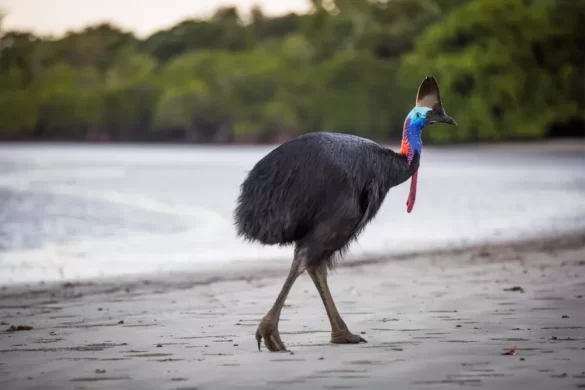
The cassowary is often called “the world’s most dangerous bird,” a title that sparks both fear and fascination. Native to the tropical rainforests of Australia, New Guinea, and nearby islands, cassowaries are large, flightless birds known for their striking appearance, powerful legs, and razor-sharp claws. Unlike many animals that rely on teeth or venom, the cassowary’s primary weapon is a long, dagger-like claw on each foot, capable of inflicting serious or even fatal injuries.
This article provides a comprehensive, evidence-based exploration of why the cassowary is considered the world’s most dangerous bird. It covers its biology, behavior, habitat, historical attacks, ecological importance, conservation status, and safety guidelines.
What Is a Cassowary?
Taxonomic Classification
The cassowary belongs to the genus Casuarius, within the ratite group of flightless birds. Ratites also include ostriches, emus, rheas, and kiwis. There are three extant species of cassowary:
- Southern Cassowary (Casuarius casuarius) – The largest and most well-known species
- Northern Cassowary (Casuarius unappendiculatus)
- Dwarf Cassowary (Casuarius bennetti)
Among these, the southern cassowary is most commonly associated with human interactions and documented attacks.
Physical Characteristics
Cassowaries are among the heaviest birds on Earth, second only to the ostrich by weight. Key physical traits include:
Height: Up to 6 feet (1.8 meters)
Weight: 110–160 pounds (50–75 kg)
Plumage: Coarse, black, hair-like feathers
Head: Brightly colored blue and red skin
Casque: A helmet-like structure made of keratin
Legs: Thick, muscular, and powerful
Claws: A dagger-like claw on each foot, up to 5 inches (12 cm) long
It is this claw, capable of inflicting deep puncture wounds, that makes the cassowary particularly dangerous.
Why Is the Cassowary Considered the World’s Most Dangerous Bird?
The Lethal Claw
The cassowary’s inner toe claw is anatomically designed for defense. Unlike talons used primarily for grasping prey, the cassowary’s claw functions as a slashing weapon. When threatened, the bird can leap and kick forward, delivering powerful strikes capable of:
- Severing arteries
- Causing internal bleeding
- Penetrating vital organs
In documented cases, cassowary kicks have resulted in severe lacerations, broken bones, and death.
Speed, Strength, and Agility
Cassowaries can run at speeds of up to 30 miles per hour (50 km/h) through dense forest terrain. They can also jump vertically and swim effectively. Combined with exceptional balance and leg strength, this makes them extremely difficult to evade once provoked.
Territorial and Defensive Behavior
Cassowaries are solitary and highly territorial animals. They are most aggressive when:
- Protecting eggs or chicks
- Defending feeding territory
- Feeling cornered or surprised
- Habituated to humans and food sources
Unlike predators that attack for sustenance, cassowary aggression is defensive, which can make it unpredictable.
Cassowary Attacks on Humans: Facts and Statistics
How Common Are Attacks?
Cassowary attacks on humans are rare, but they are well-documented. A comprehensive historical review of cassowary-human interactions shows that most incidents involve:
- Humans approaching too closely
- Feeding cassowaries
- Presence of dogs
- Encounters near roads or urban edges
Fatal attacks are extremely uncommon but not unheard of.
Notable Fatal Incident
In 1926, a 16-year-old boy in Australia died after being kicked by a cassowary while hunting it with his brother. The bird severed a major vein, leading to fatal blood loss. This remains the most frequently cited fatal cassowary attack in recorded history.
Injury Patterns
Non-fatal injuries often include:
- Deep puncture wounds
- Severe lacerations
- Nerve damage
- Infections due to contaminated wounds
Medical experts emphasize that cassowary-inflicted wounds should be treated as surgical emergencies.
Cassowary Behavior: Aggressive or Defensive?
Natural Temperament
Cassowaries are not natural predators and do not hunt animals. They are primarily frugivores and spend most of their time foraging alone. In the wild, cassowaries prefer to avoid humans.
Aggression typically occurs only when:
- A cassowary feels threatened
- Its escape route is blocked
- It is defending territory or chicks
- It has become habituated to humans due to feeding
The Role of Human Interaction
Human behavior is a major factor in cassowary incidents. Feeding cassowaries teaches them to associate people with food. Over time, this can lead to bold and demanding behavior, increasing the risk of conflict.
From a wildlife management perspective, cassowaries are dangerous only when humans ignore safety guidelines.
Habitat and Geographic Distribution
Where Cassowaries Live
Cassowaries inhabit tropical rainforests, favoring areas with dense vegetation and abundant fruit. Their range includes:
- Northeastern Australia (Queensland)
- Papua New Guinea
- Nearby islands such as Ceram and Aru
They may also venture into swamps, mangroves, and forest edges.
Territory and Range Size
Cassowaries require large territories to survive. A single adult may roam across several square kilometers, depending on food availability. Habitat loss directly increases human-cassowary encounters by forcing birds into populated areas.
Conservation Status of the Cassowary
Are Cassowaries Endangered?
The southern cassowary is listed as Endangered in Australia. Population estimates suggest fewer than 4,500 individuals remain in the wild.
Primary Threats
Major threats include:
- Habitat destruction
- Vehicle collisions
- Dog attacks
- Illegal feeding
- Climate change
Human behavior plays a direct role in both cassowary mortality and aggression incidents.
Conservation Efforts
Conservation initiatives include:
- Wildlife corridors
- Road signage and speed restrictions
- Public education campaigns
- Habitat restoration projects
Long-term survival depends on coexistence strategies rather than fear-based responses.
Cassowary vs. Other Dangerous Birds
Cassowary vs. Ostrich
Ostriches are larger and faster but tend to flee rather than attack. Their kicks are powerful, but they lack the cassowary’s dagger-like claw.
Cassowary vs. Emu
Emus are generally docile and curious. While they can kick, serious injuries are rare.
The cassowary’s combination of size, weaponized anatomy, and defensive aggression makes it uniquely dangerous among birds.
How to Stay Safe Around Cassowaries
Safety Guidelines
If you encounter a cassowary:
- Remain calm and do not run
- Maintain eye contact without staring aggressively
- Back away slowly
- Place objects (e.g., backpack) between you and the bird
- Never feed or approach it
What Not to Do
- Do not turn your back
- Do not crouch
- Do not attempt to photograph at close range
- Do not bring dogs into cassowary habitats
Education and respect are the most effective safety measures.
Conclusion
The cassowary’s reputation as the world’s most dangerous bird is not a product of exaggeration but of biological reality and documented evidence. However, danger does not equate to villainy. Cassowaries are vital to rainforest ecosystems, culturally significant to Indigenous communities, and increasingly vulnerable due to human activity.
By understanding cassowary behavior, respecting wildlife guidelines, and supporting conservation efforts, humans can coexist safely with these remarkable birds. Fear fades with knowledge, and in the case of the cassowary, respect is the key to safety and survival.
Frequently Asked Questions (FAQ)
1. Are cassowaries really the most dangerous birds in the world?
Cassowaries are considered the most dangerous due to their powerful legs and sharp claws. However, attacks are rare and usually defensive.
2. How many people have been killed by cassowaries?
Confirmed fatal incidents are extremely rare, with fewer than a handful documented in over a century.
3. Can cassowaries be domesticated?
No. Cassowaries are wild animals and should never be kept as pets.
4. Why do cassowaries attack humans?
Most attacks occur when cassowaries feel threatened, are protecting offspring, or have been conditioned to associate humans with food.
5. Where are cassowaries found?
Cassowaries live in tropical rainforests of northern Australia, New Guinea, and surrounding regions.
6. Are cassowaries protected by law?
Yes. In Australia, cassowaries are protected under environmental and wildlife conservation laws.
7. What should I do if I encounter a cassowary?
Remain calm, maintain eye contact, back away slowly, and place an object between you and the bird.
 Facebook
  Instagram
  Youtube
 English
  Spanish