
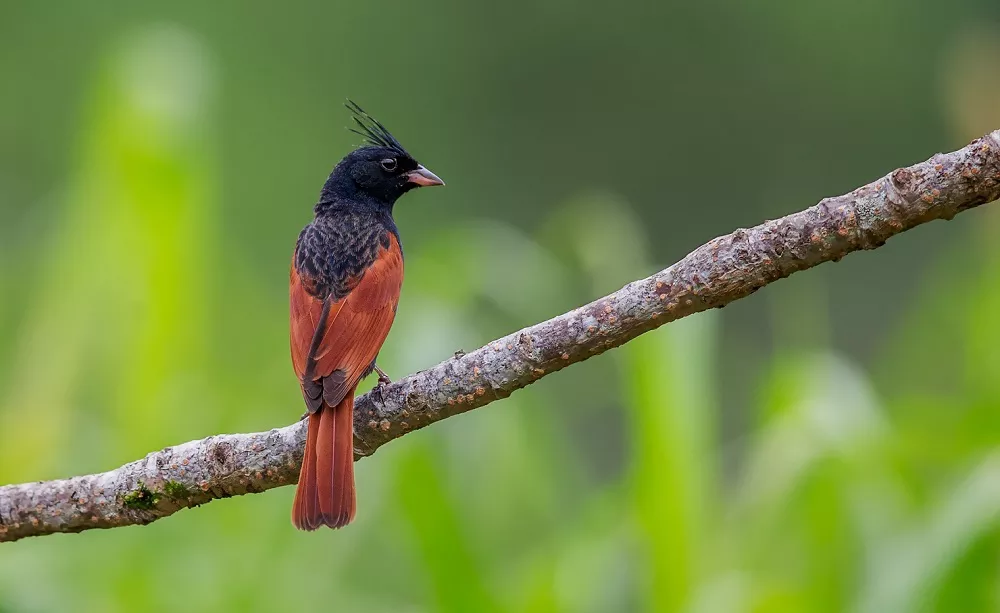
The Crested Bunting (Emberiza lathami) is a small, eye-catching songbird found across parts of South and Southeast Asia. It is especially notable for its pointed crest, strong seasonal plumage differences, and its preference for open hillsides and grasslands.
This article explains its classification, appearance, habitat, behavior, breeding, conservation status, and a few fun facts.
Scientific Classification
Crested Bunting is placed in the genus Emberiza and family Emberizidae. It is a passerine bird, meaning it belongs to the songbird.
| Rank | Classification |
|---|---|
| Kingdom | Animalia |
| Phylum | Chordata |
| Class | Aves |
| Order | Passeriformes |
| Family | Emberizidae |
| Genus | Emberiza |
| Species | Emberiza lathami |
Physical Description
The Crested Bunting is a medium-sized bunting, typically measuring 17–19 cm (6.7–7.5 inches) in length. Its most defining feature is the erect black crest, which gives the species its name.
Key Features:
- Size: Approximately 17–19 cm (6.7–7.5 inches) in length.
- Weight: Around 25–35 grams.
- Male Plumage: Bold black-and-white coloration with a striking contrast; black head, crest, throat, and upperparts, with white underparts and wing patches.
- Female Plumage: More subdued, with brownish tones and less contrast, offering camouflage.
- Beak: Short, conical, and strong—ideal for seed eating.
- Tail: Moderately long with visible white edges during flight.
The sharp contrast in the male’s coloration makes it easy to identify in the field.
Habitat and Distribution
The species ranges across the Himalayan foothills and adjoining areas of South and Southeast Asia, including parts of India, Nepal, Bhutan, Bangladesh, Pakistan, China, and mainland Southeast Asia. It is generally associated with open, dry habitats rather than dense forest. Typical environments include grassy slopes, scrub, rocky hillsides, open cultivation, and terraced areas with scattered bushes.
Crested Bunting is often partly migratory or locally migratory, moving to lower elevations outside the breeding season. In many places, it shifts seasonally between higher breeding grounds and lower wintering areas. This altitude-based movement helps it follow food availability and suitable habitat.
Behavior and Diet
Crested Bunting feeds mainly on seeds, which is typical for buntings, but it also takes small insects and other invertebrates, especially during the breeding season. It forages on the ground or in low vegetation, often in open areas where seeds are easy to find. This makes it more likely to be seen hopping among grasses or perched on low shrubs than high in the canopy.
The species is usually seen singly, in pairs, or in small groups, though it may gather in loose flocks outside the breeding season. Its song is generally described as a simple bunting-like call or song used for territory and mate attraction. Like many buntings, it relies on vocal display as much as plumage during the breeding period.
Breeding and Life Cycle
Breeding is a crucial part of the Crested Bunting’s life cycle and usually between April and August:
- Nesting: Nests are small and cup-shaped, constructed with grass, moss, and fine twigs. Often placed low in shrubs or rocky crevices for protection.
- Eggs: 3–5 eggs per clutch; eggs are pale with fine speckles.
- Incubation: Lasts about 12–14 days, with the female primarily incubating.
- Fledging: Chicks leave the nest roughly two weeks after hatching and begin foraging under parental guidance.
- Breeding Behavior: Males perform elevated perch singing to attract females and defend territory.
Conservation Status
The Crested Bunting is currently listed as Least Concern by the IUCN, indicating stable populations. Nevertheless, localized threats exist:
- Primary Threats: Habitat loss due to deforestation, agricultural expansion, and urbanization.
- Conservation Efforts: Protected areas in the Himalayas, research programs, and local awareness campaigns.
- Human Interaction: Bird watchers and eco-tourists are encouraged to observe responsibly to avoid disturbing habitats.
Protecting the Crested Bunting also helps preserve the broader ecosystem, including other species that share the same habitat.
Conclusion
The Crested Bunting (Emberiza lathami) is a small but remarkable bird that adds beauty and melody to its mountainous habitats. Its distinctive crest, melodious songs, and adaptable behaviors make it a captivating subject for bird watchers and nature enthusiasts.
FAQs
Q1: What does a Crested Bunting eat?
A: Primarily seeds, with occasional insects during the breeding season.
Q2: Where can I see Crested Buntings in the wild?
A: Himalayan foothills, northeastern India, Bhutan, Myanmar, and parts of Southeast Asia.
Q3: How can I distinguish a Crested Bunting from similar species?
A: Its prominent black-tipped crest, brown streaked plumage, and melodic song are distinguishing features.
Q4: Is the Crested Bunting endangered?
A: No, it is currently classified as Least Concern, though habitat loss poses localized threats.
 Facebook
  Instagram
  Youtube
 Spanish
  English