

The Arctic Redpoll is a name traditionally associated with the pale, northern redpoll forms found in Arctic and subarctic regions. These small finches are known for their red forehead patches, delicate bills, and remarkable variation in plumage. Birdwatchers often search for Arctic Redpoll information to learn how to identify these birds and distinguish them from other redpolls.
However, there is an important taxonomic detail to understand. In 2024, the American Ornithological Society (AOS) combined Common Redpoll, Hoary Redpoll, and Lesser Redpoll into a single species called the Redpoll (*Acanthis flammea*). Under this classification, the name Arctic Redpoll is not a separate accepted species name. It is associated with the historically recognized northern forms of the redpoll group, particularly the form known as the Hornemann’s Redpoll, formerly classified as *Acanthis hornemanni*.
This change does not mean that the birds’ visible differences have disappeared. Pale and darker redpolls can still look remarkably different. Understanding their appearance, habitat, behavior, and changing classification helps birdwatchers identify them more accurately.
What Is an Arctic Redpoll?
The name Arctic Redpoll has traditionally referred to a pale redpoll associated with the far northern regions of North America and Greenland. It is closely connected with the historical classification of Hoary Redpolls, which were recognized separately from Common Redpolls in many field guides.
Redpolls belong to the finch family, Fringillidae. They are small seed-eating songbirds adapted to cold northern environments. Their typical features include a short, conical bill, a notched tail, pale wing bars, and a small red patch on the forehead.
The word “poll” refers to the head. The name redpoll describes the distinctive reddish crown marking found in these birds.

Scientific Name and Taxonomy
The scientific name most closely associated with the traditional Arctic Redpoll concept is Acanthis hornemanni. This name was historically used for Hoary Redpoll, with hornemanni associated with the larger and especially pale northern form.
Under the 2024 AOS classification, however, Common Redpoll (Acanthis flammea), Hoary Redpoll (Acanthis hornemanni), and Lesser Redpoll (Acanthis cabaret) are treated as one species: Redpoll, Acanthis flammea.
The International Ornithologists’ Union also lists the redpoll taxa together under the name Redpoll in its relevant checklist treatment.
Consequently, readers may encounter different names depending on the publication date, regional checklist, or taxonomic authority being followed.
For bird identification, it remains useful to understand the traditional terms because many field guides, photographs, and older records use them.
Arctic Redpoll Identification
The most useful way to recognize the traditional Arctic or Hoary Redpoll form is to look at its overall color, streaking, bill, and wing pattern rather than relying on one feature.
Appearance and Plumage
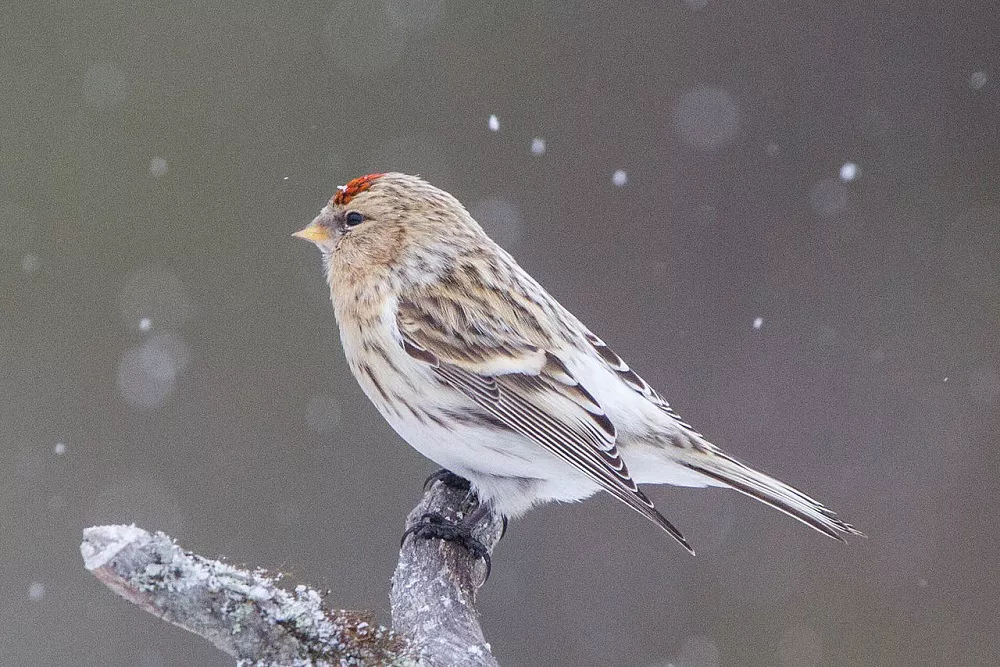
The traditional Hoary Redpoll form is generally paler than the typical Common Redpoll form. Its plumage can appear almost white in favorable lighting, with subtle gray or brown markings.
Typical identification features include:
- Red forehead patch: A small reddish area on the forehead is a characteristic feature of redpolls.
- Pale body: The traditional Hoary form usually has a whitish or frosty appearance.
- Light streaking: The back and flanks often show less prominent streaking than those of darker redpolls.
- White rump: A relatively unstreaked white rump can be a useful supporting field mark.
- Short bill: The bill is often small and short-looking compared with that of darker redpoll forms.
- White wing bars: Pale bars across the wings help create the typical redpoll pattern.
- Notched tail: The tail has a shallow notch at its tip.
These characteristics vary among individuals. Some birds identified historically as Hoary Redpolls have noticeable brown markings, while some birds from darker forms may appear relatively pale.
No single feature is sufficient to identify every bird confidently.
Male, Female, and Juvenile Differences
Adult males generally show a more noticeable red forehead patch. Some also have a pinkish wash across the breast.
Females and immature birds tend to lack the same degree of pink coloration. They may have a pale body with a red crown patch and varying amounts of brown or gray streaking.
Juveniles can be particularly difficult to identify because their plumage differs from that of adults. Their markings may be less distinctive, and their overall appearance can overlap with that of other redpoll forms.
For reliable identification, consider several characteristics together. Age, sex, lighting, feather wear, and individual variation can all influence appearance.

Image source: birdnet
Arctic Redpoll vs Common Redpoll
Arctic Redpoll and Common Redpoll have traditionally been compared because their plumage can look noticeably different despite their close relationship.
Under the current AOS treatment, these names refer to forms within a single Redpoll species rather than two separate species. The comparison remains useful for understanding field identification and historical terminology.
| Feature | Traditional Arctic or Hoary Form | Traditional Common Form |
|---|---|---|
| Overall appearance | Usually pale and whitish | Usually darker and more brownish |
| Body streaking | Often lighter and less extensive | Often more prominent |
| Rump | Commonly pale with little streaking | Often more visibly marked |
| Bill | Often appears shorter and smaller | Often appears more substantial |
| Breast | May show a pale pink wash in males | Males often show a more noticeable rosy wash |
| Geographic association | Traditionally associated with high Arctic regions | Associated with a broader range of northern habitats |
| Identification | Pale plumage can be helpful, but is not conclusive | Darker plumage and stronger streaking are useful clues |
These are general tendencies, not absolute rules. The degree of variation within redpolls makes some individuals difficult to assign confidently to a traditional form.
Which Features Are Most Reliable?
When comparing redpolls, examine the whole bird.
Start with the overall color. A very pale bird with light flank streaking may fit the traditional Hoary form. A browner bird with stronger streaking may fit the traditional Common form.
Next, examine the rump, undertail coverts, and bill. These areas can provide additional clues when viewed clearly.
Finally, consider the bird’s location, season, age, and sex. Geographic information can support an identification, but it should not replace visible evidence.
Photographs can also be misleading. Bright sunlight, snow reflections, overexposure, and camera white balance may make a bird appear whiter than it actually is.
For a more detailed comparison of their appearance and field marks, read our guide to Arctic Redpoll vs Common Redpoll.
Arctic Redpoll vs Hoary Redpoll
The relationship between Arctic Redpoll and Hoary Redpoll depends on how the names are being used.
Hoary Redpoll was historically treated as a species separate from Common Redpoll. Its scientific name was *Acanthis hornemanni*. The name Hornemann’s Redpoll has also been associated with the particularly pale, large-bodied northern form.
Arctic Redpoll is a name used in some contexts for these northern redpolls, but common-name usage has not always been consistent. It is therefore important to check the scientific name and the taxonomic system used by a particular source.
Under the 2024 AOS classification, Hoary Redpoll is no longer recognized as a separate species. Its former taxonomic group is included within Redpoll, *Acanthis flammea*.
For this reason, an article or field guide describing Arctic Redpoll as a distinct species may be using an older classification or a different naming convention.
When identifying a bird, it is useful to record both the observed features and the taxonomic authority used. This approach makes bird records easier to interpret as classification systems change.
Habitat and Geographic Range
Redpolls are birds of northern environments. Their habitats include Arctic tundra, subarctic scrub, open woodland, and areas where seed-producing shrubs and trees are available.
The traditional Arctic or Hoary Redpoll form is especially associated with high northern latitudes. Historically described breeding areas include parts of the Canadian Arctic and Greenland, although the precise geographic boundaries depend on the taxonomic group being discussed.
Breeding Habitat
During the breeding season, redpolls use northern landscapes with suitable nesting sites and reliable food supplies.
Common habitat features include:
- Low willow and birch shrubs.
- Tundra edges with scattered woody vegetation.
- Open scrubland.
- Subarctic woodland margins.
- Areas with abundant seeds and seasonal insect food.
The presence of suitable shrubs is important because these plants provide both food and potential nesting locations.
Winter Habitat
Outside the breeding season, redpolls may move into a wider range of northern habitats. Depending on local conditions and food availability, they can be found in shrublands, open forests, weedy fields, and areas with birch or alder trees.
Some birds visit backyard feeders during winter, particularly when natural food supplies are limited or when regional movements bring flocks into populated areas.
Redpoll movements can be irregular. In some years, large numbers move farther south than usual in response to changing food availability. These movements are known as irruptions.
A bird seen far south of the Arctic should not automatically be identified as an Arctic or Hoary Redpoll. Location is only one part of the identification process.
Diet and Feeding Behavior
Redpolls feed primarily on seeds. Their short, conical bills are well suited to handling small seeds from trees, shrubs, and herbaceous plants.
Common food sources include seeds from birches, alders, willows, and various weeds. Catkins can be particularly important because they provide accessible food in northern habitats.
Redpolls may also eat buds and small insects, especially when insects are available during the warmer breeding season.
How Redpolls Find Food
Redpolls are active foragers. They move among branches, inspect seed clusters, and use their bills to extract food.
They sometimes hang upside down while feeding. This behavior allows them to reach seeds that are difficult to access from a normal perching position.
Outside the breeding season, redpolls often gather in flocks. Group feeding can allow birds to exploit temporary food sources efficiently.
Feeding Redpolls at Backyard Feeders
In parts of North America, redpolls occasionally visit backyard feeders during winter.
Useful feeder foods include:
- Nyjer seed.
- Small sunflower seeds.
- Other small seeds suitable for finches.
A feeder may attract redpolls during an irruption year, but their presence is not guaranteed. Their movements depend partly on regional food availability and other environmental conditions.
If you observe a pale redpoll at a feeder, take clear photographs from several angles. Images showing the back, rump, flanks, and undertail area can help support a more careful identification.
Behavior and Social Life
Redpolls are active, social finches. Outside the breeding season, they commonly travel and feed in flocks that may contain many individuals.
Their movements can be rapid and energetic. A flock may forage quietly in a group of shrubs before suddenly taking flight when disturbed.
Redpolls produce a variety of calls, including sharp, buzzy notes and more complex chattering sounds. These vocalizations help birds maintain contact while moving through vegetation or flying together.
Their small size and active feeding behavior can make them challenging to observe for long periods. Birdwatchers often have the best opportunities when flocks settle to feed.
Seasonal Movements
Redpoll movements are not always predictable. Rather than following a simple migration route every year, some populations move according to food conditions.
This behavior explains why redpolls can appear in large numbers in some winters but remain scarce in others.
The timing and extent of these movements vary by region and population. It is important to distinguish regular seasonal movements from occasional irruptions when interpreting sightings.
Breeding and Nesting
Redpolls generally breed during the northern spring and summer, when temperatures rise and food becomes more available.
Nesting typically takes place in shrubs or small trees. Willow and birch vegetation may provide suitable locations in northern breeding habitats.
The female generally builds the nest and incubates the eggs, while the male contributes to feeding and other parental activities. Both parents can play important roles in raising the young.
Exact nesting dates, clutch sizes, and other breeding details vary across the redpoll complex. Information reported for Common Redpoll should not automatically be treated as a precise description of every bird traditionally classified as an Arctic or Hoary Redpoll.
Because these birds have been taxonomically grouped together in some modern classifications, research and field records may also use different names for populations that older literature treated separately.
For a species-specific breeding study, consult the relevant regional field guide or ornithological research and check which taxonomic concept it follows.
Adaptations to Arctic Conditions
Redpolls survive in environments where temperatures can fall well below freezing and winter daylight is limited.
Their survival depends on several complementary adaptations rather than on one unique feature.
Flexible Feeding Behavior
Their ability to exploit small seeds from different plants helps them use food resources that remain available through much of the year.
This flexibility is particularly important in northern habitats, where food supplies can change with the season.
Use of Sheltered Habitats
Shrubs, trees, and other vegetation provide feeding sites and shelter from wind. In winter, sheltered locations can help birds reduce exposure to harsh weather.
Seasonal Movement
When local food supplies become scarce, some redpolls move to other areas. These movements help them take advantage of changing seed availability.
Cold-Weather Survival
Redpolls, like other small northern songbirds, rely on insulation from their feathers and on maintaining adequate energy intake.
Some redpolls have also been documented using snow shelters at night. Snow can provide insulation from colder air above the surface.
These behaviors illustrate how small birds can survive in demanding climates through a combination of physiological and behavioral adaptations.
Conclusion
The Arctic Redpoll is an interesting subject for birdwatchers because its traditional identity combines a distinctive pale appearance with a complex taxonomic history.
A red forehead patch, pale plumage, light streaking, and a relatively small bill can help distinguish the traditional Hoary Redpoll form from darker redpolls. However, no single field mark guarantees a correct identification.
FAQs About Arctic Redpoll
1. Is the Arctic Redpoll the Same as the Hoary Redpoll?
The names are closely related in historical usage, but they are not necessarily interchangeable in every source. Arctic Redpoll has been used for northern redpolls, while Hoary Redpoll was the established name for the taxon *Acanthis hornemanni*. Check the scientific name and classification used by the source.
2. How Can You Identify an Arctic Redpoll?
Look for a pale overall appearance, a red forehead patch, light streaking, white wing bars, a small bill, and a pale rump. These characteristics can support identification, but individual variation and overlap with other redpoll forms make some birds difficult to classify.
3. Where Does the Arctic Redpoll Live?
The traditional Arctic or Hoary Redpoll group is associated with high northern latitudes, including Arctic and subarctic habitats. Its historical breeding range includes parts of the Canadian Arctic and Greenland. Exact range boundaries depend on the taxonomic group and reference being used.
4. What Does an Arctic Redpoll Eat?
Redpolls mainly eat small seeds from plants such as birches, alders, willows, and weeds. They may also eat buds and small insects when these foods are available.
5. Does the Arctic Redpoll Migrate?
Redpolls make seasonal movements, but their movements can be irregular. Some move farther south during winters when food availability changes. These occasional large movements are called irruptions.
6. How Is an Arctic Redpoll Different From a Common Redpoll?
The traditional Hoary form is generally paler, with lighter streaking and a smaller-looking bill. The traditional Common form is usually browner and more heavily streaked. These differences overlap, and the AOS now treats the groups as one species.
 Facebook
 Instagram
 Youtube

 Spanish
 English