
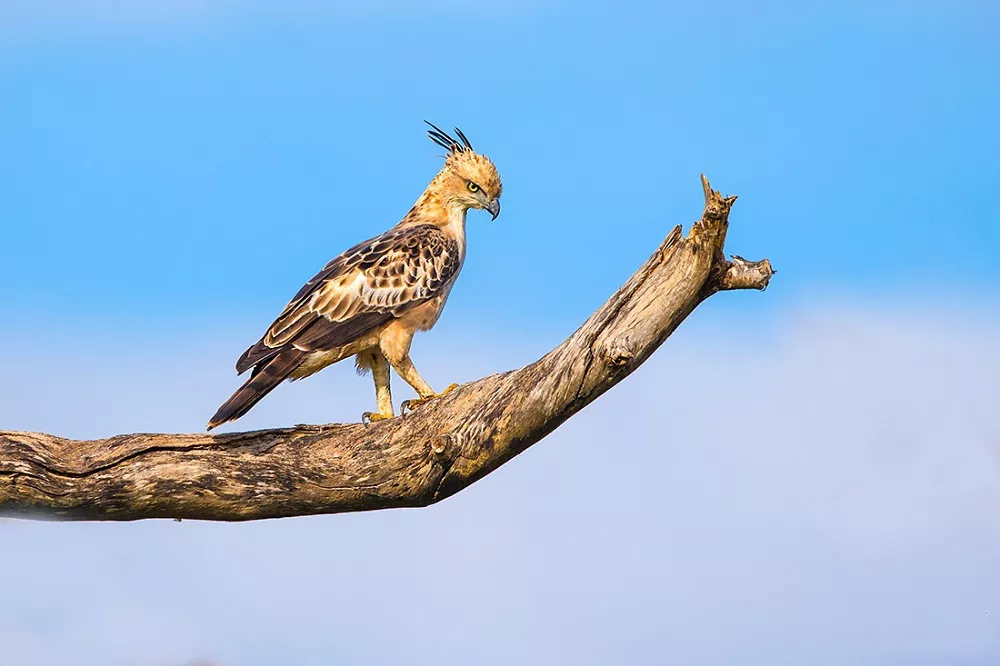
The Changeable Hawk-Eagle is one of Asia’s most impressive birds of prey. Known for its striking appearance, powerful hunting skills, and remarkable variation in plumage. Found across South and Southeast Asia, the species thrives in forests, woodlands, and even some human-modified landscapes.
In this article, you’ll learn everything about the Changeable Hawk-Eagle, including its identification, habitat, diet, behavior, breeding habits, conservation status, and interesting facts.
What Is a Changeable Hawk-Eagle?
The Changeable Hawk-Eagle (Nisaetus cirrhatus) is a medium-to-large eagle belonging to the Accipitridae family, which includes hawks, eagles, kites, and vultures.
Its common name comes from its highly variable appearance. Individuals can differ significantly in coloration, crest length, and plumage patterns, making identification challenging for beginners.
Quick Facts
| Feature | Details |
|---|---|
| Scientific Name | Nisaetus cirrhatus |
| Common Name | Changeable Hawk-Eagle |
| Family | Accipitridae |
| Order | Accipitriformes |
| Length | 60–75 cm (24–30 in) |
| Wingspan | 110–165 cm (43–65 in) |
| Weight | 1.2–2.5 kg (2.6–5.5 lbs) |
| Diet | Birds, mammals, reptiles |
| Habitat | Forests, woodlands, hills, plantations |
| Distribution | South Asia and Southeast Asia |
| Lifespan | Up to 20 years in the wild |
| Conservation Status | Least Concern (IUCN) |
How to Identify a Changeable Hawk-Eagle
The Changeable Hawk-Eagle is a medium-to-large eagle characterized by a long crest, broad wings, and powerful talons.
Key Identification Features
1. Prominent Crest
One of the most distinctive features is the long, pointed crest on the back of the head. The crest can vary in length and is often raised when the bird is alert or excited.
2. Variable Plumage
As its name suggests, the species exhibits considerable variation in coloration.
Common forms include:
- Pale morphs with creamy-white underparts
- Darker brown morphs
- Intermediate forms with mixed coloration
3. Strong Yellow Legs
The legs are heavily feathered down to the tarsi and end in large yellow feet equipped with formidable talons.
4. Striking Eyes
Adults typically possess bright yellow to golden eyes that contribute to their fierce appearance.
5. Tail Pattern
The tail usually displays several dark bands across a lighter background, aiding identification during flight.
Male vs Female
Like many birds of prey, females are noticeably larger than males.
| Characteristic | Male | Female |
|---|---|---|
| Size | Smaller | Larger |
| Weight | 1.2–1.8 kg | 1.8–2.5 kg |
| Plumage | Similar | Similar |
| Hunting Role | Active hunter | Active hunter and nest defender |
Sexes appear very similar in coloration, making size one of the primary distinguishing factors.
Distribution and Range
The Changeable Hawk-Eagle has one of the broadest distributions among Asian forest eagles.
This species is distributed in India, Sri Lanka, Nepal, Bhutan, Bangladesh, Myanmar, Thailand, Cambodia, Laos, Vietnam, Malaysia, Indonesia, Brunei, Singapore, and the Philippines.
Its wide distribution demonstrates its remarkable ecological adaptability.
Habitat Preferences
Tropical Rainforests
Primary and secondary forests provide excellent hunting opportunities and nesting sites.
Dry Deciduous Forests
The species frequently inhabits seasonal forests with open canopies.
Mangrove Forests
Coastal populations may occur near mangrove ecosystems.
Woodlands and Forest Edges
Unlike some forest-specialist eagles, the Changeable Hawk-Eagle tolerates partially disturbed habitats.
Agricultural Landscapes
In some regions, individuals hunt near plantations, farmland, and rural settlements.
Diet and Hunting Behavior
The Changeable Hawk-Eagle is an apex predator within many forest ecosystems.
What Does the Changeable Hawk-Eagle Eat?
Its diet includes a wide range of prey species.
Birds
Common avian prey include:
- Pigeons
- Doves
- Junglefowl
- Parakeets
- Hornbills
- Waterbirds
Mammals
The eagle frequently captures:
- Squirrels
- Rats
- Tree shrews
- Bats
- Small monkeys
Reptiles
Reptilian prey includes:
- Lizards
- Monitor lizards
- Snakes
Occasionally, amphibians may also be consumed.
Hunting Techniques
Perch Hunting
The eagle often waits silently on elevated perches before launching surprise attacks.
Ambush Flights
Using forest cover, it approaches prey undetected and strikes with tremendous speed.
Aerial Pursuit
Bird prey may be chased through forest openings or above the canopy.
Its combination of stealth, agility, and strength makes it one of the most efficient forest hunters in Asia.
Behavior and Lifestyle
Solitary Nature
Changeable Hawk-Eagles are generally solitary birds except during the breeding season.
Most adults maintain territories that provide adequate food resources and nesting sites.
Territorial Behavior
Breeding pairs vigorously defend their territory against:
- Other hawk-eagles
- Large raptors
- Potential nest predators
Territorial displays often involve soaring flights and vocalizations.
Vocalizations
The species produces a variety of calls, including:
- High-pitched whistles
- Piercing screams
- Repeated territorial calls
These calls are especially common during courtship and breeding periods.
Breeding and Reproduction
Breeding Season
Breeding timing varies geographically but generally coincides with periods of food abundance.
Many populations breed during the dry season or early rainy season.
Courtship Displays
Courtship includes:
- Spectacular aerial displays
- Mutual soaring
- Calling duets
- Food exchanges
These behaviors help strengthen pair bonds.
Nest Construction
The nest is a large platform built from sticks and branches.
Nest Location
Typical nest sites include:
- Tall emergent trees
- Forest canopies
- Large woodland trees
Nests may be reused and expanded over multiple years.
Eggs and Incubation
Clutch Size
Most pairs lay one egg at a time, but occasionally they may lay two eggs.
Incubation Period
The incubation period takes about 40–45 days. The female undertakes most of the incubation work, while the male is responsible for providing food.
Chick Development
After hatching:
- Chicks are covered in white down.
- Parents provide constant protection.
- Young birds remain dependent for several months.
Fledging typically occurs after approximately 10–12 weeks.
Conservation Status
The Changeable Hawk-Eagle is currently classified as: Least Concern.
Why It Is Not Currently Threatened
Several factors contribute to its stability:
- Large geographic range
- Adaptability to different habitats
- Broad diet
- Relatively healthy population
However, local declines occur where forests disappear rapidly.
Conservationists continue monitoring populations across Asia to ensure long-term survival.
Interesting Facts About the Changeable Hawk-Eagle
- The species derives its name from its highly variable plumage patterns.
- Females can be significantly larger than males.
- It is capable of capturing prey nearly equal to its own weight.
- The crest can change appearance depending on mood and alertness.
- It occupies more habitat types than many other forest eagles.
- Juveniles often look very different from adults.
- Some pairs reuse the same nest for many consecutive years.
- It is among the most adaptable eagle species in tropical Asia.
Conclusion
The Changeable Hawk-Eagle (Nisaetus cirrhatus) is one of Asia’s most captivating birds of prey. Combining powerful hunting abilities, remarkable adaptability, and highly variable plumage, it occupies a unique place among the world’s raptors. From tropical rainforests and mountain woodlands to mangroves and forest edges, this eagle has successfully adapted to a wide variety of environments.
Frequently Asked Questions (FAQs)
Is the Changeable Hawk-Eagle dangerous to humans?
No. Like most wild raptors, it generally avoids people and poses little risk unless directly threatened near a nest.
Why is it called the Changeable Hawk-Eagle?
The changeable hawk-eagle is one of the most widely distributed, adaptable, and numerous birds of prey. Their plumage colors vary greatly, ranging from light to dark, and change with molting and age, hence the name “changeable”.
What is the lifespan of a Changeable Hawk-Eagle?
Wild individuals may live up to 20 years or more under favorable conditions.
Can Changeable Hawk-Eagles hunt monkeys?
Yes. Although uncommon, they are capable of capturing small monkeys and other medium-sized mammals.
Where can I see a Changeable Hawk-Eagle in the wild?
The species can be observed in protected forests throughout India, Sri Lanka, Thailand, Malaysia, Indonesia, and other parts of South and Southeast Asia.
 Facebook
  Instagram
  Youtube
 Spanish
  English