

What bird has the largest wingspan in the world? The Wandering Albatross (Diomedea exulans) holds this distinction among living birds. Its typical wingspan measures approximately 2.5–3.5 meters (8.2–11.5 feet), and a documented record specimen reached 3.63 meters (11 feet 11 inches). This remarkable seabird uses its enormous wings to glide across the Southern Ocean while expending relatively little energy.
The Wandering Albatross is more than a record-breaking bird. Its specialized wings, long-distance movements, and unusual breeding behavior make it one of the most fascinating species in the bird world.
In this guide, you will discover how large its wings can grow, how it flies so efficiently, where it lives, and how it compares with other birds known for their impressive wingspans.
What Bird Has the Largest Wingspan in the World?
The Wandering Albatross is widely recognized as the living bird with the largest wingspan.
According to Guinness World Records, the largest documented wingspan of a living bird was 3.63 meters (11 feet 11 inches). The measurement belonged to a male Wandering Albatross caught by members of the Antarctic research ship USNS Eltanin in the Tasman Sea on September 18, 1965.
However, this record should not be confused with the bird’s typical wingspan. Most adult Wandering Albatrosses have wingspans within the approximate range of 2.5–3.5 meters (8.2–11.5 feet), according to the [Natural History Museum](https://www.nhm.ac.uk/discover/what-is-the-biggest-bird-in-the-world.html).
A wingspan is the distance between the tips of a bird’s fully extended wings. It is different from body length, height, and weight.
The Wandering Albatross is particularly impressive because its wings are extremely long relative to its body. This design helps it travel across vast expanses of ocean without relying on continuous, energy-intensive flapping.
Although other albatross species and large soaring birds also have impressive wingspans, the Wandering Albatross remains the leading answer when people ask which living bird has the largest wingspan.
How Big Is a Wandering Albatross’s Wingspan?
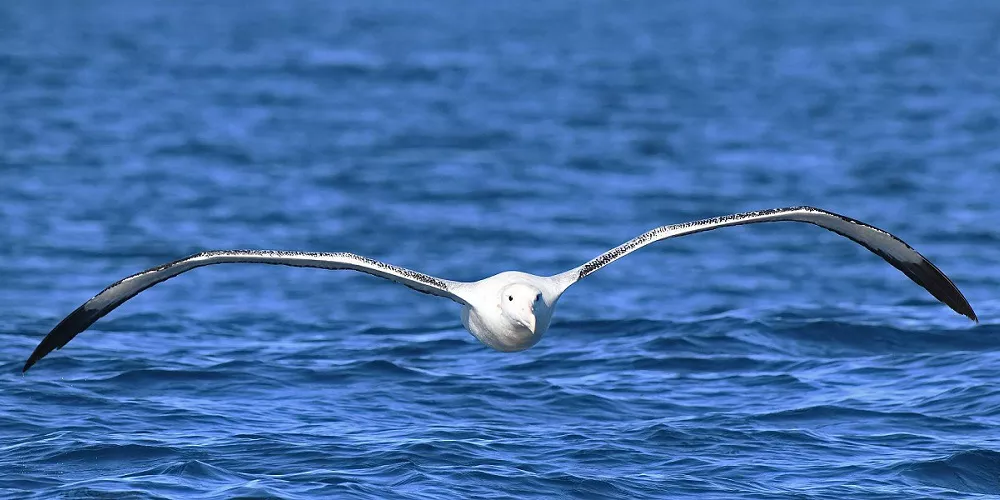
The Wandering Albatross is known for having the largest wingspan of any living bird.
The Wandering Albatross has a wingspan that can exceed 3 meters (9.8 feet). Its wings are long, narrow, and well suited to efficient gliding over the ocean.
Here are the key facts about this species.
| Feature | Details |
|---|---|
| Common name | Wandering Albatross |
| Scientific name | Diomedea exulans |
| Typical adult wingspan | Approximately 2.5–3.5 m (8.2–11.5 ft) |
| Largest documented wingspan | 3.63 m (11 ft 11 in) |
| Approximate adult body length | Around 1–1.35 m (3.3–4.4 ft), depending on the reference and individual |
| Main habitat | Southern Ocean and surrounding waters |
| Diet | Mainly squid and fish, with other documented marine food sources |
| Conservation status | Vulnerable, according to the cited conservation assessments |
Imagine standing beneath a bird whose wings stretch more than 11 feet from tip to tip. Its broad reach allows it to take advantage of winds above the sea, maintaining forward movement while minimizing the need for powerful wingbeats.
The wingspan also helps explain why the Wandering Albatross is so well adapted to life far from land. Rather than spending most of its time flying with repeated flapping, it can use the wind to cover extensive distances while searching for food.
One important distinction remains: the 3.63-meter measurement is a historical record for an individual bird, not the expected wingspan of every adult.
Why Does the Wandering Albatross Have Such Long Wings?
The Wandering Albatross’s wings are specialized for long-distance flight. Their shape helps the bird generate lift while limiting the energy needed to remain airborne.
Three adaptations are particularly important.
1. Long, Narrow Wings
The wings of the Wandering Albatross have a high aspect ratio. In simple terms, they are long in relation to their width.
This shape is useful for gliding because it helps reduce induced drag, the aerodynamic resistance associated with producing lift. Less drag means the bird can travel efficiently without constantly flapping its wings.
The species is therefore especially suited to flying across open water, where favorable winds can continue over large distances.
2. Dynamic Soaring
One of the most remarkable abilities of the Wandering Albatross is dynamic soaring.
Wind speed differs at different heights above the ocean. The bird takes advantage of these changes by following a repeated flight path that allows it to gain energy from the wind.
It can rise into faster-moving air, turn, and descend toward the water before repeating the maneuver. By carefully changing its position and direction, the albatross can maintain flight with relatively little flapping.
Research published in *Royal Society Open Science* has examined this behavior using GPS-tracked Wandering Albatrosses and aerodynamic models. The findings demonstrate how the species exploits wind shear to support efficient, long-distance flight.
3. A Lifestyle Built Around the Ocean
The Wandering Albatross spends much of its life traveling across the open ocean. Its long wings are especially valuable in this environment because suitable winds can provide energy for sustained gliding.
The bird can search large areas for food without repeatedly returning to land. This helps it exploit prey that may be widely distributed across the Southern Ocean.
However, its flight is not completely effortless. Wind conditions, foraging requirements, breeding responsibilities, and weather all influence how far and efficiently an individual can travel.
Its remarkable wings provide an advantage, but they work as part of a complete system of anatomy and behavior adapted to oceanic life.
Where Does the Wandering Albatross Live?
The Wandering Albatross lives across the Southern Ocean, including Antarctic, sub-Antarctic, and some subtropical waters.
Its breeding colonies are located on remote islands in the Southern Hemisphere. Important breeding areas include South Georgia, the Crozet and Kerguelen island groups, and Macquarie Island.
These locations provide suitable nesting habitat while allowing adults access to productive ocean waters.
Unlike many birds that spend most of their lives around forests, lakes, or coastal environments, Wandering Albatrosses are highly adapted to the open sea. They can travel far from their breeding colonies while searching for food.
The Australian Antarctic Program reports that young birds may remain at sea for five to ten years before returning to their natal island to breed. First breeding generally occurs only after several years of development, with many birds beginning reproduction at approximately nine or ten years of age.
This extended period at sea is one reason the Wandering Albatross is difficult to study. Tracking devices and long-term observations help researchers understand where these birds travel and how they use different parts of the ocean.
For more information about its distribution, see the Australian Antarctic Program’s Wandering Albatross profile.
What Does the Wandering Albatross Eat?
The Wandering Albatross is a carnivorous seabird. Its diet consists mainly of squid and fish, although it also consumes other marine organisms and scavenges when opportunities arise.
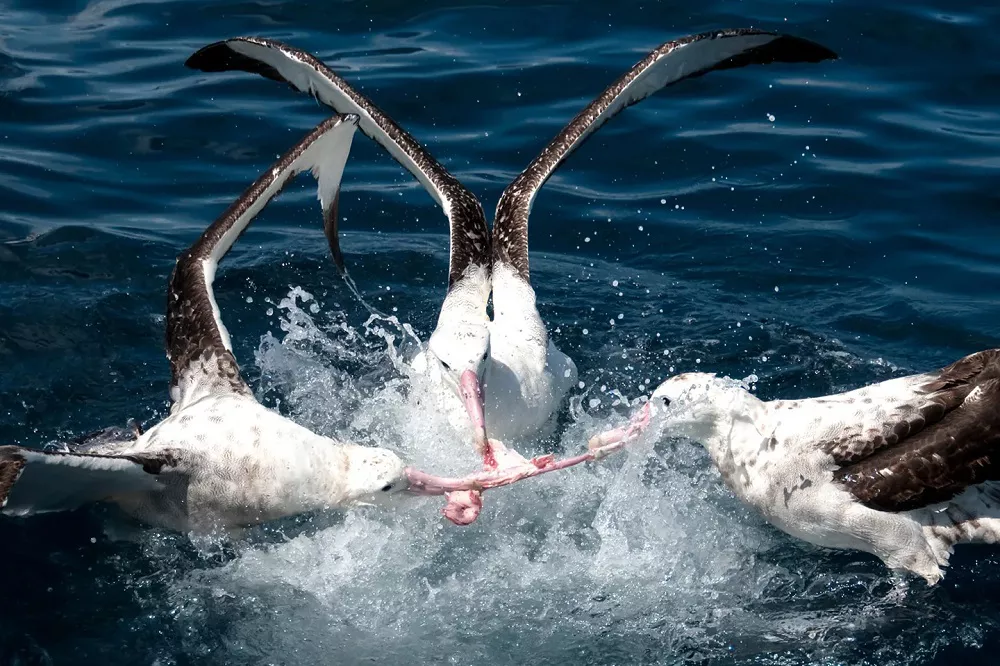
Documented food sources include:
- Squid and other cephalopods: Important prey for birds foraging across oceanic waters.
- Fish: Another major component of its diet.
- Crustaceans and other marine organisms: Additional food sources taken when available.
- Carrion and discarded food: Albatrosses may consume floating carcasses or scavenge food associated with fishing vessels.
The bird generally searches for food across large areas of the sea. It may feed at the ocean’s surface rather than routinely diving deep underwater.
Its long wings are useful during foraging because they allow it to cover considerable distances while searching for patches of prey.
The availability of food also affects its breeding success. Adults must find enough resources to maintain their own condition and provide food for their chicks over an extended nesting period.
According to the Australian Museum’s Wandering Albatross profile, squid and fish are preferred foods, while scavenging is also part of its feeding behavior.
How Far Can the Wandering Albatross Fly?
The Wandering Albatross is famous for its extensive movements across the Southern Ocean.
The Natural History Museum reports that Wandering Albatrosses can travel up to approximately 120,000 kilometers (74,565 miles) in a year, potentially circling the Southern Ocean several times.
This figure illustrates the species’ extraordinary mobility, but it should not be interpreted as a fixed annual distance for every individual.
Travel patterns vary with age, sex, breeding stage, food availability, and weather conditions. Birds raising chicks often need to balance longer foraging trips with the need to return to their nests.
The species’ ability to travel far is closely related to its flight adaptations. Dynamic soaring helps it use wind energy, reducing the effort required to move between feeding areas.
Long-distance travel is especially important in an environment where prey is spread across vast oceanic regions. Instead of depending on a small, fixed feeding area, the bird can search over a much larger area for suitable food.
Its movements are a reminder that the size of a bird’s wingspan is not simply a visual characteristic. In the Wandering Albatross, it is closely connected to survival, feeding, and reproduction.
Birds with the Largest Wingspans: How Does the Wandering Albatross Compare?
Several living birds have exceptionally large wingspans. Some are oceanic seabirds, while others are soaring birds that search for food over mountains, grasslands, and wetlands.
The following comparison illustrates how the Wandering Albatross measures up against other large-winged species.
| Bird species | Reported wingspan | Main habitat | Distinguishing feature |
|---|---|---|---|
| Wandering Albatross | Usually 2.5–3.5 m; documented record 3.63 m | Southern Ocean | Widest wingspan record among living birds |
| Southern Royal Albatross | More than 3 m; reported up to 3.6 m | Southern Ocean | Another exceptionally large albatross |
| Andean Condor | Up to approximately 3.2 m | Andes and western South America | One of the world’s largest soaring land birds |
| Marabou Stork | Up to approximately 3.2 m in some references | Sub-Saharan Africa | Large scavenger with broad wings |
| California Condor | Approximately 3 m | Western North America | One of the largest North American land birds |
These figures are reported measurements rather than a perfectly standardized comparison. Maximum values can vary among references, and not every species has been measured under identical conditions.
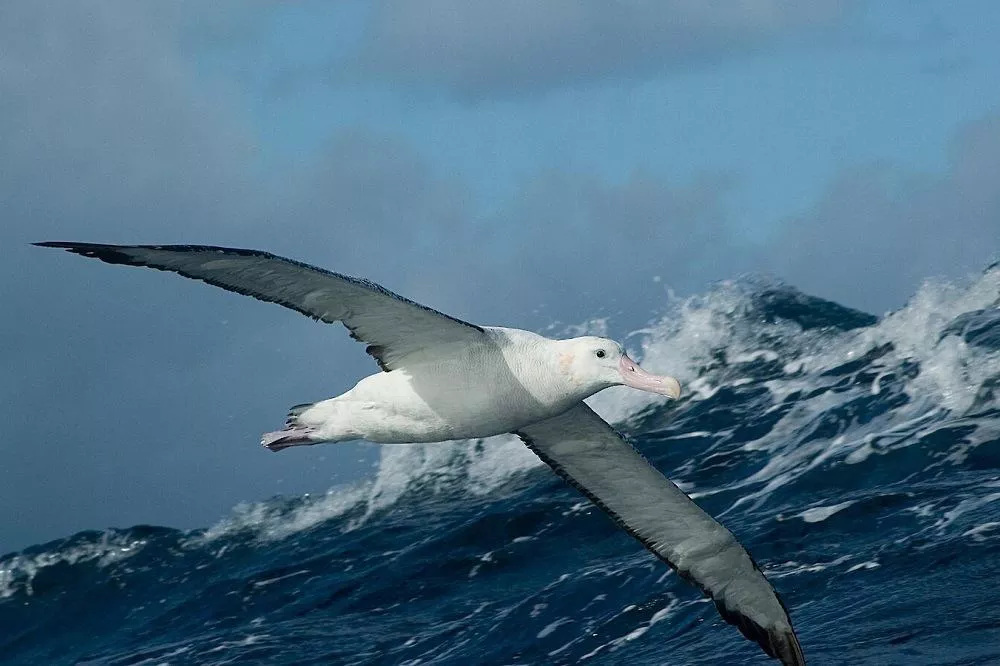
Wandering Albatross vs Southern Royal Albatross
The Southern Royal Albatross is one of the closest comparisons to the Wandering Albatross. Its wingspan can exceed 3 meters, and some references report measurements reaching approximately 3.6 meters.
The Wandering Albatross is generally recognized as the living bird with the largest wingspan, supported by the widely cited 3.63-meter record. However, the reported maximum sizes of these two species are close enough that it would be misleading to assume every Wandering Albatross has longer wings than every Southern Royal Albatross.
Wandering Albatross vs Andean Condor
The Andean Condor has a wingspan of up to approximately 3.2 meters (10 feet 6 inches), according to the San Diego Zoo.
This is impressive for a bird that soars over mountainous terrain and open landscapes. However, the documented maximum wingspan of the Wandering Albatross is greater.
The two species also have different ecological roles. The Wandering Albatross searches for food over the ocean, while the Andean Condor is primarily a scavenger that searches for carrion over land.
Wandering Albatross vs Marabou Stork
The Marabou Stork is another large-winged bird, reaching approximately 3.2 meters in wingspan in some published references.
It inhabits parts of sub-Saharan Africa, where it frequents savannas, wetlands, riverbanks, and areas with available carrion. Its broad wings help it soar over large areas while searching for food.
Although the Marabou Stork is an impressive bird, its reported maximum wingspan is generally below the Wandering Albatross’s documented record.
Is the Wandering Albatross the Largest Bird Ever to Exist?
No. The Wandering Albatross is generally considered the living bird with the greatest wingspan, but some extinct birds may have had substantially larger wings.
One important group is the Pelagornithidae, an extinct family of large seabirds known for their unusual tooth-like projections along the edges of their bills.
Fossil evidence suggests that some members of this group may have had wingspans approaching 6 meters (19.7 feet). These birds lived millions of years ago and occupied marine environments.
Their enormous size is reconstructed from fossil remains rather than measured directly from complete wings. Estimates therefore depend on the available fossils, anatomical comparisons, and scientific models.
The Natural History Museum’s overview of the world’s largest birds discusses the impressive wingspans of extinct seabirds and the challenges involved in comparing them with living species.
It is also important to distinguish wingspan records from other measures of size.
The ostrich, for example, is the largest living bird by height and overall body mass in many comparisons, but it cannot fly. The Wandering Albatross holds a different distinction: the greatest wingspan among living birds.
These categories answer different questions, so they should not be treated as interchangeable rankings.
Wandering Albatross Conservation and Threats
Despite its impressive wingspan and ability to travel thousands of kilometers, the Wandering Albatross faces significant conservation challenges.
The species is assessed as Vulnerable in the cited conservation references, including the Australian Antarctic Program and BirdLife International. Conservation status can change as populations and assessments are updated, so the current assessment should be rechecked before publication.
One of its major threats is accidental capture in commercial fishing operations.
Longline Fishing
Longline fishing uses lines carrying many baited hooks. Wandering Albatrosses may approach fishing vessels to feed on discarded material or bait and become hooked or entangled.
This accidental capture, known as bycatch, can kill adult birds before they reproduce or return to their colonies.
Because Wandering Albatrosses mature slowly and typically produce a chick only about every two years when breeding successfully, the loss of breeding adults can have a substantial effect on population recovery.
Threats at Breeding Colonies
Introduced predators and other environmental pressures can also affect albatross populations, particularly where breeding birds and chicks are vulnerable on nesting islands.
The scale of these effects depends on the island and local conditions. Conservation measures therefore need to consider both threats at sea and threats on land.
Conservation Efforts
BirdLife International and its partners have worked with fishing industries and governments to reduce seabird bycatch. Measures can include bird-scaring lines, improved handling of baited hooks, and adjustments to fishing practices designed to keep seabirds away from dangerous equipment.
Protecting breeding sites and improving monitoring are also important.
You can learn more about the threats facing albatrosses and the conservation response through BirdLife International’s albatross overview.
The Wandering Albatross demonstrates why a species can be highly adapted to its natural environment and still remain vulnerable to human activities. Protecting it requires conservation efforts across both oceanic feeding grounds and breeding colonies.
Fascinating Facts About the Wandering Albatross
The Wandering Albatross has several biological features that distinguish it from other large birds.
1. It can live for decades. Wandering Albatrosses are long-lived seabirds. Some individuals have been recorded living for more than 60 years, although lifespan varies.
2. It reproduces slowly. A breeding pair usually raises one chick per breeding attempt. Successful pairs generally do not breed every year because raising a chick takes a substantial amount of time and energy.
3. It has a long period of development. Young birds may spend five to ten years at sea before returning to their birth island to breed.
4. Its plumage changes as it matures. Juveniles are much darker than fully mature adults. Their plumage gradually becomes lighter as they age.
5. It uses the wind as a source of flight energy. Dynamic soaring allows the bird to travel long distances with relatively little flapping.
6. It is one of the most mobile seabirds. Individuals can travel across much of the Southern Ocean and may cover very large distances during a year.
7. It is a dedicated parent. Both adults participate in incubation and chick care. Raising a chick can occupy much of the breeding year.
These adaptations help explain how the Wandering Albatross survives in a demanding environment where food is widely distributed and breeding opportunities are limited.
Conclusion
The Wandering Albatross is the living bird with the largest wingspan, with typical measurements reaching approximately 3.5 meters and a documented record of 3.63 meters (11 feet 11 inches).
Its long, narrow wings help it exploit ocean winds, travel enormous distances, and search for food across the Southern Ocean. These adaptations make it one of the most remarkable examples of efficient flight in the bird world.
Frequently Asked Questions
1. What bird has the largest wingspan in the world?
The Wandering Albatross (*Diomedea exulans*) is widely recognized as the living bird with the largest wingspan. Its typical wingspan is approximately 2.5–3.5 meters (8.2–11.5 feet).
2. What is the largest recorded wingspan of a living bird?
Guinness World Records documents a wingspan of 3.63 meters (11 feet 11 inches) for a male Wandering Albatross measured in 1965. This is a record measurement, not the average wingspan of the species.
3. How many feet wide is a Wandering Albatross?
A Wandering Albatross typically has a wingspan of approximately 8.2–11.5 feet. The documented record is 11 feet 11 inches.
4. Is the Wandering Albatross bigger than the Andean Condor?
The Wandering Albatross generally has the greater wingspan. Its typical wingspan reaches approximately 3.5 meters, while the Andean Condor can reach about 3.2 meters. However, body mass and overall body dimensions are different measurements and should be compared separately.
5. Which bird has the largest wingspan on land?
The Andean Condor is one of the largest-winged land-soaring birds, with a reported wingspan of up to approximately 3.2 meters (10 feet 6 inches). The exact answer can depend on how land-dwelling species and maximum measurements are defined, so the distinction should not be confused with the Wandering Albatross’s broader record among living birds.
6. Why does the Wandering Albatross have such long wings?
Its long, narrow wings help it glide efficiently and reduce the energy needed to stay airborne. The bird uses dynamic soaring to gain energy from differences in wind speed above the ocean, allowing it to travel long distances with relatively little flapping.
 Facebook
 Instagram
 Youtube

 Spanish
 English