
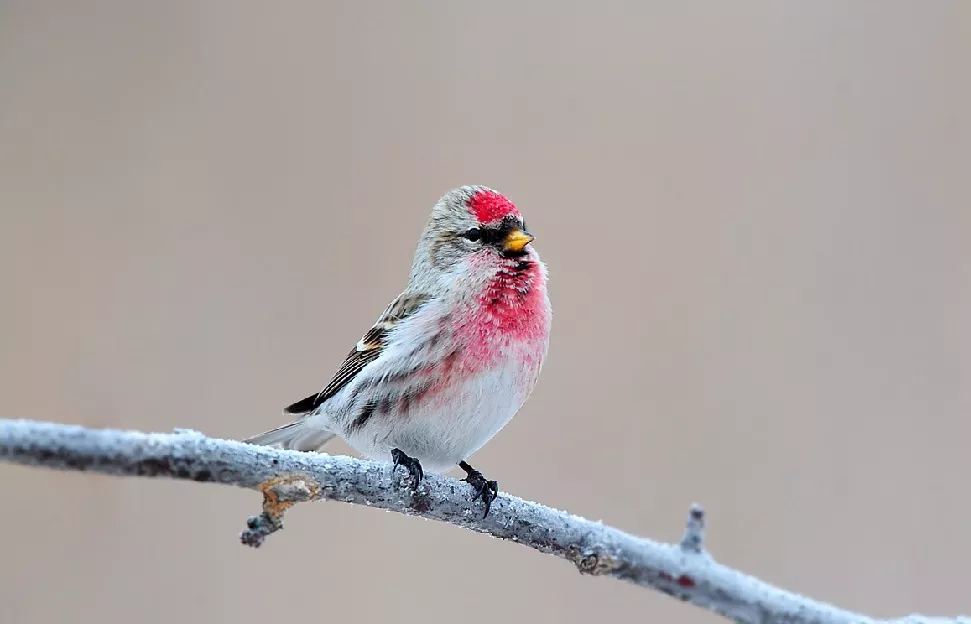
The Common Redpoll (Acanthis flammea) is a small passerine bird belonging to the finch family, Fringillidae. It is known for its bright red forehead, striped body, lively behavior, and remarkable cold tolerance. Found across the Arctic tundra, boreal forests, and northern regions of North America and Eurasia, this tiny bird has adapted perfectly to harsh winters and unpredictable food supplies.
This article explains the Common Redpoll’s appearance, range, habitat, diet, breeding behavior, migration, adaptations, lifespan, and conservation status.
Common Redpoll Overview
| Category | Information |
|---|---|
| Common Name | Common Redpoll |
| Scientific Name | Acanthis flammea |
| Family | Fringillidae |
| Order | Passeriformes |
| Type | Small finch / songbird |
| Length | 11.5–14 cm (4.5–5.5 inches) |
| Weight | 9–20 g (0.3–0.7 oz) |
| Wingspan | Approximately 20–25 cm (8–10 inches) |
| Main Diet | Seeds, buds, insects |
| Habitat | Arctic tundra, boreal forests, open woodlands |
| Distribution | Northern North America, Europe, and Asia |
| Conservation Status | Least Concern |
| Average Lifespan | Around 5–7 years in the wild (varies by conditions) |
What Does a Common Redpoll Look Like?
The Common Redpoll is a small, compact bird with a rounded body, short neck, and a short, pointed yellow bill. Its most recognizable feature is the small red patch on the forehead, which gives the bird its name.
The word “poll” comes from an old term meaning “head,” so “redpoll” literally means “red head.”
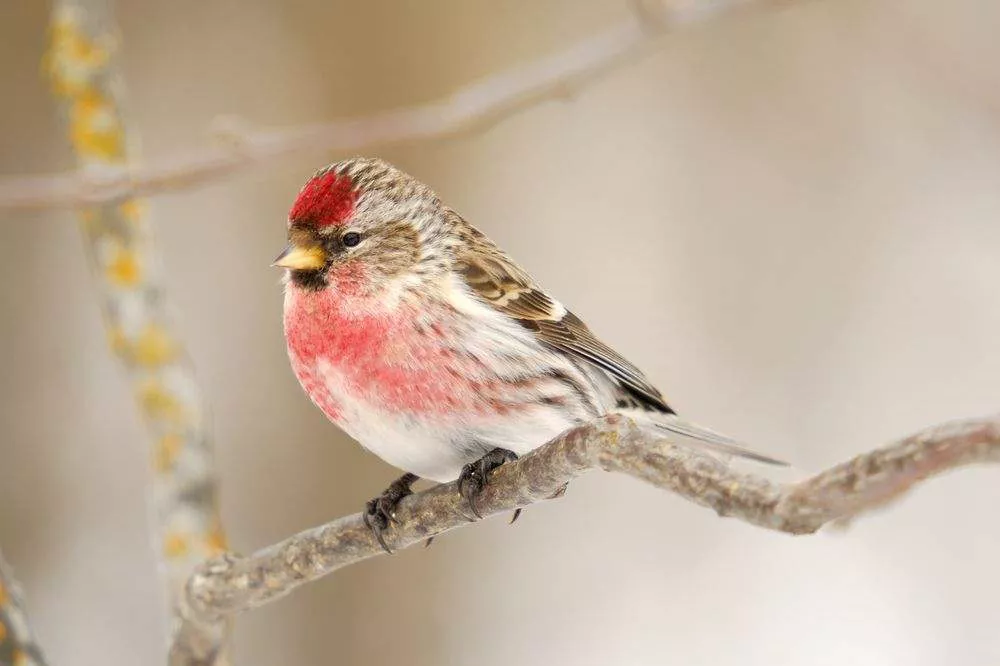
Male Common Redpoll Appearance
Adult males are usually more colorful than females. They have:
- A bright red forehead patch
- A pale face with a small black chin
- Brown-streaked back and sides
- Two noticeable white wing bars
- A soft pink or rosy color on the chest and upper body
The rosy breast feathers are especially visible during the breeding season when males display to females.
Female and Juvenile Appearance
Females and young birds are less colorful. They usually have:
- Brown and white streaked feathers
- A smaller red forehead patch
- Pale underparts with dark streaking
- Less or no pink coloration
Because females look similar to some other redpoll forms, identification can sometimes be challenging even for experienced birdwatchers.

Where Do Common Redpolls Live?
Common Redpolls are birds of the far north. They are strongly associated with cold environments, especially Arctic and subarctic regions.
Their breeding range includes:
- Northern Canada
- Alaska
- Greenland
- Scandinavia
- Northern Russia
- Siberian regions
During winter, they may travel farther south when food becomes limited. In some years, large numbers appear in southern Canada and the northern United States. These movements are called irruptions.
Unlike regular seasonal migration, irruptions happen when food availability changes. A year with poor seed production in northern forests may push thousands of Common Redpolls southward in search of food.
Common Redpoll Habitat
The Common Redpoll is highly adaptable and uses several northern habitats.
Breeding Habitat
During the breeding season, Common Redpolls prefer:
- Arctic tundra with shrubs
- Willow and birch areas
- Open boreal forests
- Spruce and pine woodland edges
These areas provide both nesting locations and food sources.
Winter Habitat
In winter, they often move into:
- Open forests
- Shrublands
- Grasslands
- Weedy fields
- Agricultural areas
- Backyard bird feeders
They especially enjoy areas containing birch, alder, and other seed-producing plants.
What Do Common Redpolls Eat?
The Common Redpoll is primarily a seed eater.
Its diet includes seeds from many northern plants, especially:
- Birch
- Willow
- Alder
- Spruce
- Pine
- Grasses
- Sedges
- Weeds
- Wildflowers
In summer, redpolls also eat insects and spiders. Animal food is particularly useful during the breeding season because growing chicks require protein.
During winter, seeds become the main food source.
At backyard feeders, Common Redpolls may eat:
- Nyjer seed
- Thistle seed
- Millet
- Sunflower seeds
Their small bills are well suited to handling small seeds.
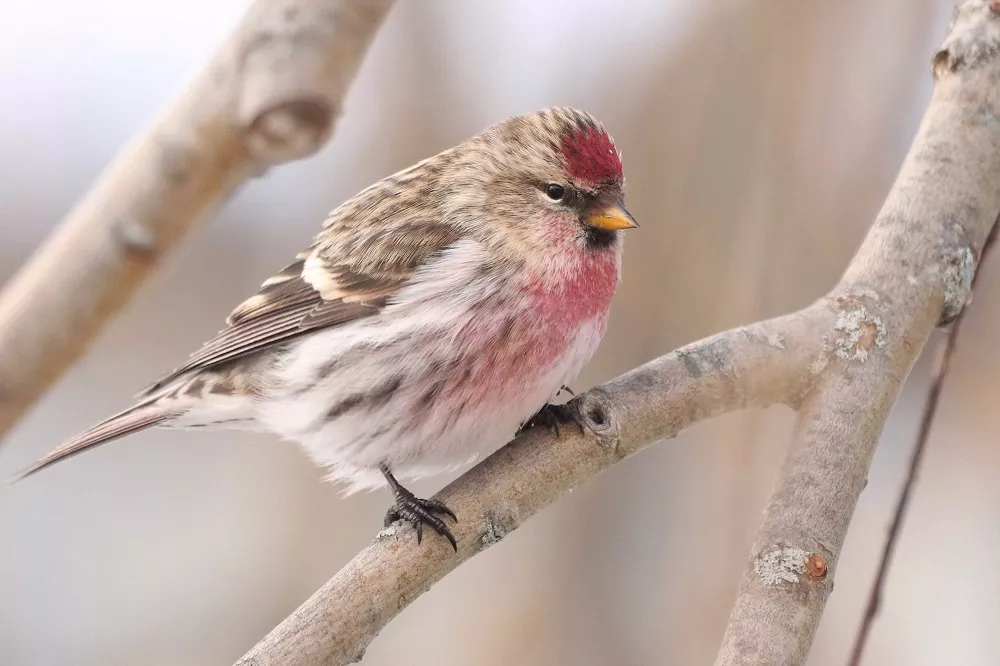
Unique Feeding Behavior
One of the most interesting behaviors of the Common Redpoll is its ability to feed upside down.
Like many finches, it can cling to thin branches and hang below them while collecting seeds. This allows it to reach food that other birds cannot easily access.
Common Redpolls often feed in large groups. A flock may contain dozens or even hundreds of individuals. Their constant movement and soft calls make them easy to recognize.
At backyard feeders, they are especially attracted to:
- Nyjer seeds
- Thistle seeds
- Millet
- Small sunflower seeds
Providing clean feeders with suitable seeds can attract these beautiful winter visitors.
Common Redpoll Behavior and Personality
Despite their small size, Common Redpolls are extremely active birds.
They are known for:
- Fast movements
- Social behavior
- Acrobatic feeding skills
- Constant communication
Their calls are often described as soft, buzzing sounds. Flocks usually remain noisy while feeding, helping members stay connected.
Flocking Behavior
Outside the breeding season, Common Redpolls are highly social. Large flocks help them:
- Find food more efficiently
- Detect predators
- Survive cold temperatures
A group can quickly move between feeding areas when local food supplies change.
See Also: Common Redpoll vs Lesser Redpoll: What’s the Difference?
How Do Common Redpolls Survive Extreme Cold?
The Arctic environment is one of the most challenging places for birds. Temperatures can fall far below freezing, yet Common Redpolls survive successfully.
They have several special adaptations.
Extra Feather Insulation
During winter, their feathers become thicker, creating a layer of trapped air that helps preserve body heat.
Efficient Food Storage
Common Redpolls have a small pouch-like area in their throat that allows them to temporarily store food. They can quickly collect seeds and later digest them in a sheltered location.
High Metabolism
Like many small birds living in cold climates, they maintain a high metabolism to produce enough body heat.
These adaptations allow them to remain active even during severe Arctic winters.
Common Redpoll Breeding and Nesting
Breeding usually occurs during the short Arctic summer when food becomes abundant.
Nest Location
Females build nests in:
- Low shrubs
- Birch trees
- Willow bushes
- Dense vegetation
The nest is usually hidden close to the ground.
Nest Materials
The nest may include:
- Twigs
- Grass
- Moss
- Bark fibers
- Feathers
The soft interior helps protect eggs and chicks from cold temperatures.
Eggs and Chicks
A typical clutch contains:
- About 4–6 eggs
The female usually handles most incubation duties, while the male provides food.
After hatching, both parents help feed the chicks until they become independent.
Common Redpoll Migration Patterns
Common Redpoll migration is unusual because it does not follow a strict yearly schedule.
Instead, movements depend mainly on:
- Seed availability
- Weather conditions
- Food shortages
Some winters bring huge numbers of Common Redpolls south, while other years very few appear.
These irregular movements are called irruptions.
Birdwatchers often look forward to redpoll irruption years because they provide opportunities to observe large flocks in areas where the birds are normally uncommon.
Conservation Status of the Common Redpoll
The Common Redpoll is currently considered a species of Least Concern, meaning it is not currently threatened with extinction.
However, scientists continue monitoring populations because northern birds face several environmental challenges.
Potential threats include:
- Climate Change
Changes in Arctic temperatures may affect:
- Breeding habitats
- Food availability
- Seasonal patterns
- Habitat Changes
Loss or alteration of boreal forests may reduce important feeding areas.
Final Thoughts
The Common Redpoll is a remarkable example of northern bird adaptation. Its small body, red crown, streaked plumage, acrobatic feeding style, and ability to survive severe winter conditions make it one of the most fascinating finches of the Arctic and boreal regions.
 Facebook
  Instagram
  Youtube
 Spanish
  English