
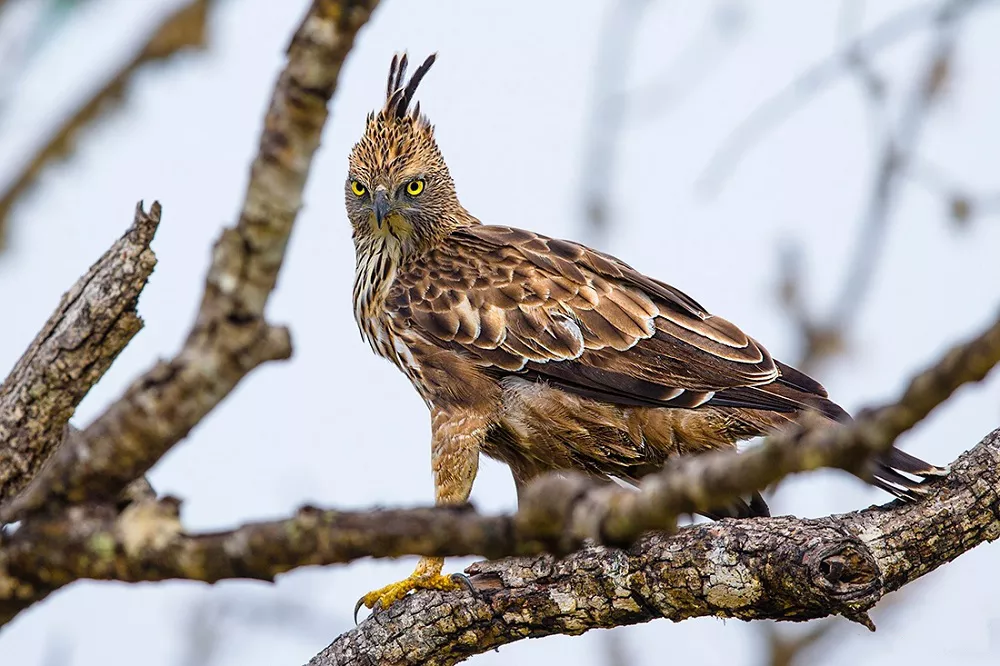
The Changeable Hawk-Eagle (Nisaetus cirrhatus) is a powerful forest raptor and an opportunistic predator that primarily hunts a wide variety of small to medium-sized prey found in woodlands and forest-edge habitats. In simple terms, it mainly eats birds, mammals, and reptiles, and it is especially known for taking animals such as pheasants, junglefowl, hares, squirrels, rats, lizards, frogs, and snakes.
In this guide, we’ll explore the complete diet of the Changeable Hawk-Eagle, how it hunts, what it feeds its chicks, and how its diet changes depending on habitat and prey availability.
Overview of the Changeable Hawk-Eagle Diet
The Changeable Hawk-Eagle is a carnivorous raptor, meaning it feeds exclusively on animal prey. It is considered an opportunistic predator, meaning it hunts whatever suitable animals are available within its territory. This makes it highly adaptable in forests, woodland edges, plantations, and open areas with tall trees.
Its diet primarily includes:
- Small to medium-sized mammals
- Birds
- Reptiles
- Occasionally amphibians and large insects
Unlike highly specialized raptors that rely on a single prey type, the Changeable Hawk-Eagle adapts its diet based on local prey availability. This flexibility is one of the key reasons for its wide distribution.
Primary Food Sources
1. Mammals (Main Energy Source)
Small mammals form a significant portion of the Changeable Hawk-Eagle’s diet. These prey provide high energy and are often easier to detect from perches or during slow soaring flights.
Common mammalian prey includes:
- squirrels
- Rats and mice
- Hares
- Small civets (occasionally, juveniles or weakened individuals)
- Bats (rare, opportunistic captures)
Squirrels are particularly important in many forest ecosystems where this eagle lives. The bird often ambushes them while they move between trees or forage on branches.
2. Birds (Highly Opportunistic Prey)
Birds are another major component of its diet. The Changeable Hawk-Eagle is highly skilled at aerial ambushes and canopy-level hunting, allowing it to catch birds in mid-flight or from roosting sites.
Common avian prey includes:
- Pigeons
- Doves
- Mynas
- Pheasants
- Junglefowl
- Waterhens
- Ducks
- Drongos
- Parakeets
Juvenile or nesting birds are especially vulnerable. The eagle often raids nests when adults are away, targeting eggs or chicks.
3. Reptiles (Seasonally Important)
In tropical regions, reptiles become more prominent in the diet, especially during warmer months when they are more active.
Typical reptile prey includes:
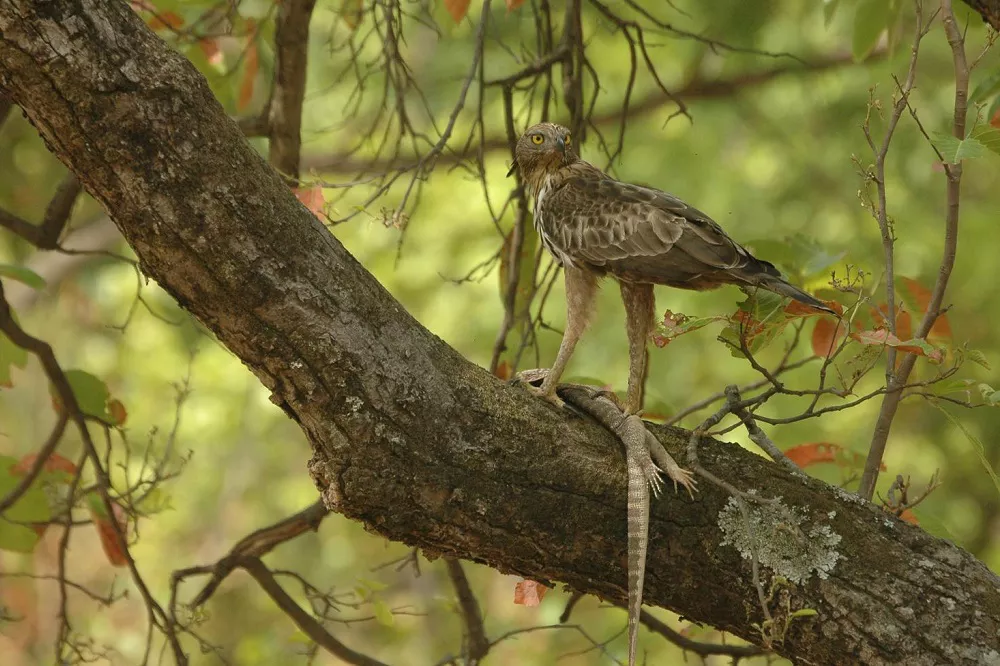
- Lizards (especially monitor lizards and agamids)
- Small snakes
- Skinks
The eagle uses its powerful talons to immobilize reptiles quickly, reducing the risk of injury from bites or tail defense.
4. Amphibians and Insects (Occasional Food Sources)
Although not primary prey, amphibians and large insects are sometimes consumed, especially by younger or less experienced individuals.
Examples include:
- Frogs and toads
- Large grasshoppers
- Beetles
These prey types usually supplement the diet when other food sources are scarce.
How Does a Changeable Hawk-Eagle Hunt?
The Changeable Hawk-Eagle is an ambush predator. It often perches upright on a high branch where it has a wide view of the ground below. From there, it scans for movement and watches for prey to appear in the open.
Once it locks onto a target, the bird launches a fast and forceful attack. It swoops down, strikes with powerful talons, and carries prey away if possible. This hunting method is very effective in forest clearings, woodland edges, and lightly wooded farmland where prey animals may be exposed.
This species is not a soaring hunter in the same way some open-country eagles are. Instead, it relies more on surprise, cover, and a strong burst of speed from a concealed position.
Habitat and Feeding Behavior
The Changeable Hawk-Eagle is commonly associated with dense forests, deciduous woodland, savanna with tall trees, plantations, and other wooded habitats. These environments are ideal for ambush hunting because they provide both cover and open patches where prey may emerge.
A key feature of the species is that it often hunts near forest edges or clearings. Those places are productive because prey animals such as birds, rodents, and reptiles frequently move between cover and open ground.
In some field accounts, the bird is described as remaining motionless on a branch for long periods before attacking suddenly. That patient hunting strategy is one reason it can succeed across such a broad ecological range.
Interesting Facts About the Changeable Hawk-Eagle’s Diet
- It can capture prey nearly half its own body weight.
- Juvenile monkeys occasionally appear in its diet.
- Large lizards are among its preferred reptilian prey.
- It can hunt effectively in both dense forests and open woodland.
- Its powerful talons can exert tremendous gripping force.
- It often swallows smaller prey whole.
- It may return repeatedly to areas with abundant prey.
Conclusion
The diet of the Changeable Hawk-Eagle is diverse, adaptable, and strongly influenced by its environment. As a forest apex predator, it primarily feeds on mammals, birds, and reptiles, adjusting its prey choices based on seasonal and ecological conditions.
Its flexible feeding behavior not only ensures its survival across a wide geographic range but also plays a vital role in maintaining ecosystem balance.
Frequently Asked Questions
Does a Changeable Hawk-Eagle eat snakes?
Yes. Snakes are a regular part of its diet, particularly in tropical regions.
Can a Changeable Hawk-Eagle catch monkeys?
Large individuals may occasionally prey upon young monkeys, although this is relatively rare.
Does a Changeable Hawk-Eagle eat fish?
Fish are not considered a major food source, but opportunistic captures can occur near water bodies.
Is the Changeable Hawk-Eagle an apex predator?
In many forest ecosystems, it functions as a top predator and has few natural enemies.
Does a Changeable Hawk-Eagle hunt at night?
No. The Changeable Hawk-Eagle is a diurnal raptor that hunts during daylight hours.
 Facebook
  Instagram
  Youtube
 Spanish
  English