
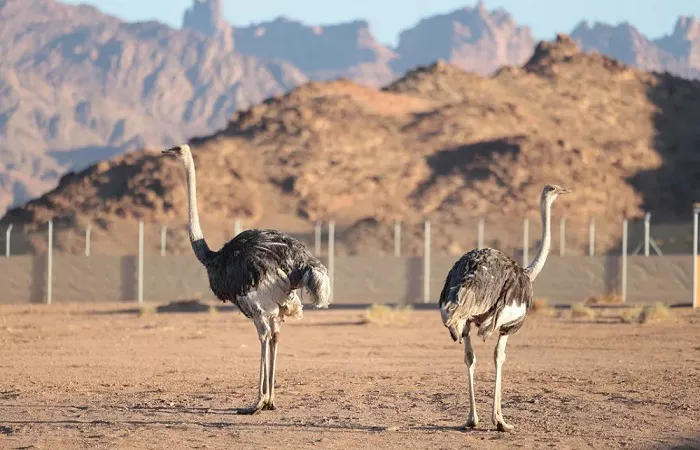
Conservationists announced in December that tall, long-legged birds known as red-necked ostriches—sometimes called “camel birds”—have been released into Saudi Arabia’s Prince Mohammed bin Salman Royal Reserve. The reserve covers about 9,460 square miles in the country’s northwest and is one of the region’s largest protected areas.
The red-necked ostrich, also known as the North African or Barbary ostrich, is being introduced as a biological stand-in for the Arabian ostrich, which once roamed the area but became extinct in 1941 due to overhunting and habitat loss. The red-necked ostrich is the closest living relative of the Arabian ostrich and shares physical traits that help it survive in harsh desert conditions.
Despite this reintroduction effort, the red-necked ostrich itself is facing serious threats. Fewer than 1,000 individuals are believed to remain in scattered populations across semi-arid regions of north-central Africa. Some experts classify the subspecies as critically endangered. Conservationists hope the newly released birds will successfully breed and help rebuild the global population.
The ostriches are the 12th species to be reintroduced to the Prince Mohammed bin Salman Royal Reserve. Other species already returned include the Arabian oryx, Persian onager, sand gazelle and mountain gazelle. The long-term restoration plan aims to reintroduce 23 native species that historically lived in the area. The project is being carried out in partnership with the National Center for Wildlife, Imam Turki bin Abdullah Royal Nature Reserve, Imam Saud bin Abdulaziz Royal Reserve, Aramco, NEOM and AlUla.
“The return of ‘camel birds’ to their historic rangelands supports the restoration of desert ecosystems shaped historically by large grazing and browsing species,” said Andrew Zaloumis, CEO of the Prince Mohammed bin Salman Royal Reserve. “Ecosystems can only be considered fully restored when lost species, or their ecological equivalents, are returned.”
The reserve contains 15 different ecosystems. Although it covers just 1 percent of Saudi Arabia’s land area and 1.8 percent of its marine territory, it is home to more than half of the country’s known species, making it one of the most biodiverse protected areas in the Middle East.
Ostriches have played a role in Middle Eastern desert ecosystems for centuries. In the first century C.E., Roman scholar Pliny the Elder referred to them as “camel birds” in his work Natural History, noting their resemblance to camels when viewed from afar. The birds also appear frequently in Arabic poetry, classical literature and oral traditions, where they are admired as symbols of strength, endurance and speed. Images of ostriches can still be found today in ancient sandstone rock carvings across the reserve.
Ostriches are among the world’s oldest birds, with ancestors dating back to the Eocene Epoch, between 56 million and 34 million years ago. They are flightless birds with large bodies, long necks and powerful legs, standing up to nine feet tall and weighing as much as 340 pounds.
Because they are nomadic, ostriches play an important role in dispersing seeds over long distances. Their feeding habits—ranging from plants and seeds to insects and small animals—help improve soil health and support nutrient cycling. Their sharp eyesight also allows them to act as early warning sentinels, alerting other animals to potential predators.
According to conservationists, the return of ostriches is critical to restoring the desert’s ecological balance and ensuring the long-term stability and health of the region’s ecosystems.
 Facebook
  Instagram
  Youtube
 English
  Spanish