
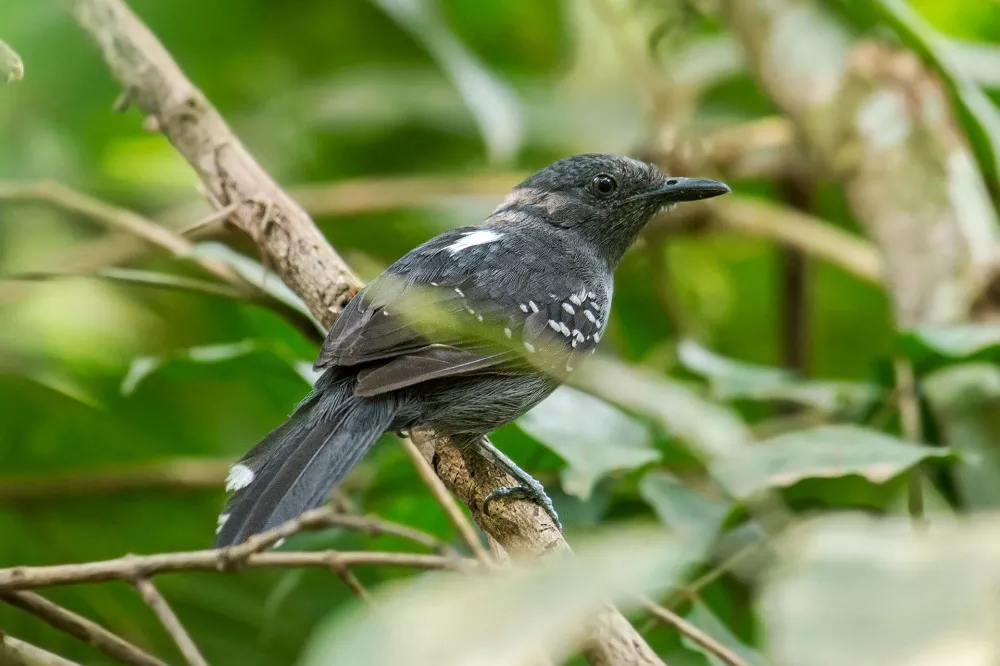
A bird long believed to be a single species spread across the Amazon rainforest has now been revealed to be several distinct species, including two that are new to science.
The discovery came from a detailed study of the gray antbird species complex and was recently reported in the journal Vertebrate Zoology.
Researchers found that what scientists had previously classified as the gray antbird (Cercomacra cinerascens) actually represents a group of different species living in separate parts of the Amazon Basin. Among them are two newly described birds: Cercomacra mura and Cercomacra raucisona, both found in southern Amazonia.
Small Birds Hidden in the Forest
Gray antbirds are small, inconspicuous birds belonging to the antbird family Thamnophilidae. They live in dense forest understory and are distributed widely across the Amazon region, including Brazil, Bolivia, Colombia, Ecuador, French Guiana, Guyana, Peru, Suriname and Venezuela.
The birds show only subtle physical differences. Males are typically gray while females are brownish, and their plumage variations are so slight that scientists have struggled to distinguish populations across the vast Amazon landscape.
Studying Museum Specimens and Birdsong
To reassess the species boundaries within the gray antbird complex, researcher Vagner Cavarzere of São Paulo State University and his colleagues conducted a comprehensive analysis of the birds’ physical features and vocalizations.
The team examined 682 preserved bird specimens from museum collections and analyzed 347 recordings of their songs. They also used BirdNET, a deep-learning system designed to classify bird sounds, to examine the structure of the birds’ calls.
Because birds rely heavily on vocal communication, their songs often serve as important markers for identifying species. According to the researchers, these vocal signals act as “acoustic signatures,” helping scientists uncover hidden diversity.
Rivers Divide the Species
The analysis revealed clear differences among bird populations separated by major Amazonian rivers.
Birds living north of the Pastaza, Marañón, Solimões and Amazon rivers consistently showed distinct color patterns and songs compared with populations living to the south.
The newly identified species also occupy different regions. Cercomacra mura is found in the forest between the Ucayali and Madeira rivers, while Cercomacra raucisona inhabits the area between the Madeira and Tapajós rivers.
According to the researchers, these rivers have acted as long-standing natural barriers that prevented bird populations from mixing. Over thousands of years, the isolated populations gradually evolved into separate species.
A Five-Species Group
In addition to describing the two new birds, the scientists also elevated several previously recognized forms to full species status. As a result, the gray antbird complex is now considered to include five distinct species.
Each species has unique vocal traits and occupies its own geographic range, with little evidence that the birds overlap or interbreed.
Revealing Hidden Biodiversity
The findings highlight how much biodiversity in the Amazon still remains to be clarified—even among birds that scientists believed were already well understood.
By combining artificial intelligence with traditional research methods such as bioacoustics and museum collections, scientists can uncover species that might otherwise remain hidden.
The researchers say identifying these species is an important first step toward protecting them as environmental changes continue to reshape the Amazon ecosystem.
 Facebook
  Instagram
  Youtube
 English
  Spanish