
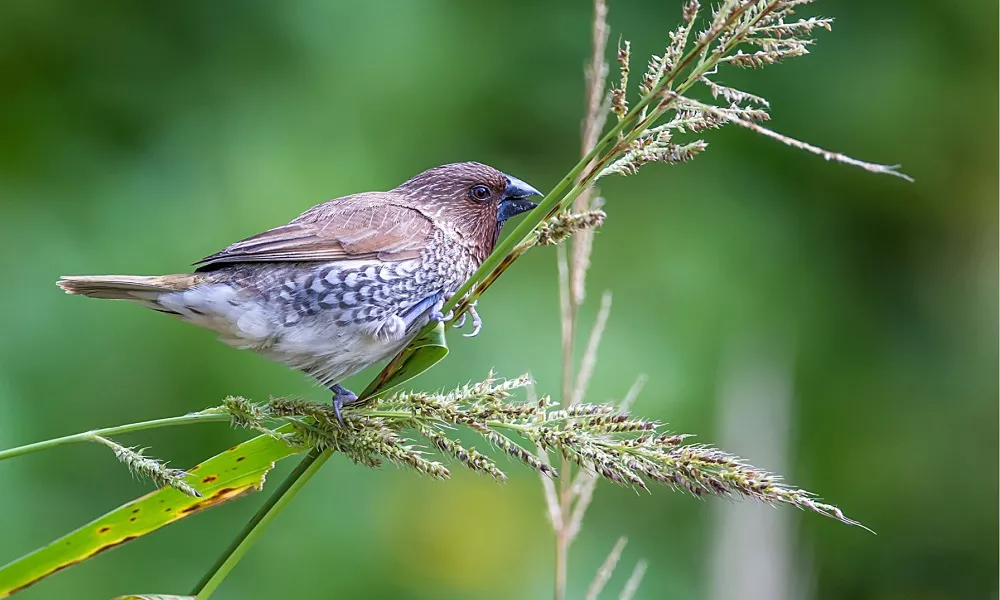
The Scaly-breasted Munia (Lonchura punctulata) is a small, social bird found across Asia and many other parts of the world. It is known for its beautiful “scale-like” feather pattern on the chest. This bird is also called the Spotted Munia or Nutmeg Mannikin.
This guide covers identification, habitat, diet, behavior, breeding, and conservation. Whether you are a bird watcher or a beginner, this article will help you understand this species clearly.
Scientific Classification
| Scientific Name | Lonchura punctulata |
| Common Name | Scaly-breasted Munia |
| Other Name | Spice Finch |
| Family | Estrildidae (Munias and Mannikins) |
| Size | 11–12 cm (4.3–4.7 inches) |
| Weight | About 11–16 grams |
| Wingspan | About 17 to 19 cm |
| Lifespan | 5–7 years in the wild; up to 10 years in captivity |
| Diet | Mainly grass seeds, plus small berries and insects |
| Habitat | Grasslands, farmland, rice fields, gardens, parks, and other open areas |
| Behavior | Social, flocking, and seed-eating |
| Conservation Status | Least Concern |
How to Identify a Scaly-breasted Munia
Physical Appearance
This bird is best known for its unique feather pattern.
- Head and upperparts: Warm brown to chestnut
- Underparts: White or pale buff with dark “scale-like” markings
- Beak: Short, thick, bluish-gray
- Tail: Short and slightly rounded
- Legs: Gray
The scale pattern on the breast and belly is the most important identification feature.
Male vs Female
Males and females look almost identical. There is no obvious color difference. Behavior during breeding season may help distinguish them.
Juvenile Birds
Young birds lack the scaled pattern. They have plain brown underparts. The pattern develops as they mature.
Distribution and Range
Native Range
The Scaly-breasted Munia is native to:
- India and Sri Lanka
- Southern China
- Southeast Asia (Thailand, Vietnam, Malaysia, Indonesia)
Introduced Populations
Due to human activity, it has spread to:
- Japan
- Hawaii and mainland United States
- Australia
- Parts of Africa
It is now considered one of the most widely distributed munia species.
Habitat Preferences
This species thrives in a variety of environments.
Common Habitats
- Grasslands
- Rice fields and farmland
- Open woodland
- Urban parks and gardens
Habitat Adaptability
Scaly-breasted Munias are highly adaptable. They prefer areas with abundant grass seeds and water sources. They often live close to human settlements.
Behavior and Social Structure
Social Behavior
These birds are highly social.
- Often seen in flocks of 10–50 individuals
- Roost together at night
- Communicate with soft calls
Daily Activity
- Active during the day (diurnal)
- Spend much time foraging on the ground
- Quick and direct flight
Vocalization
Their calls are soft, short, and repetitive. They are not loud singers but maintain constant contact within flocks.
Diet and Feeding Habits
Main Diet
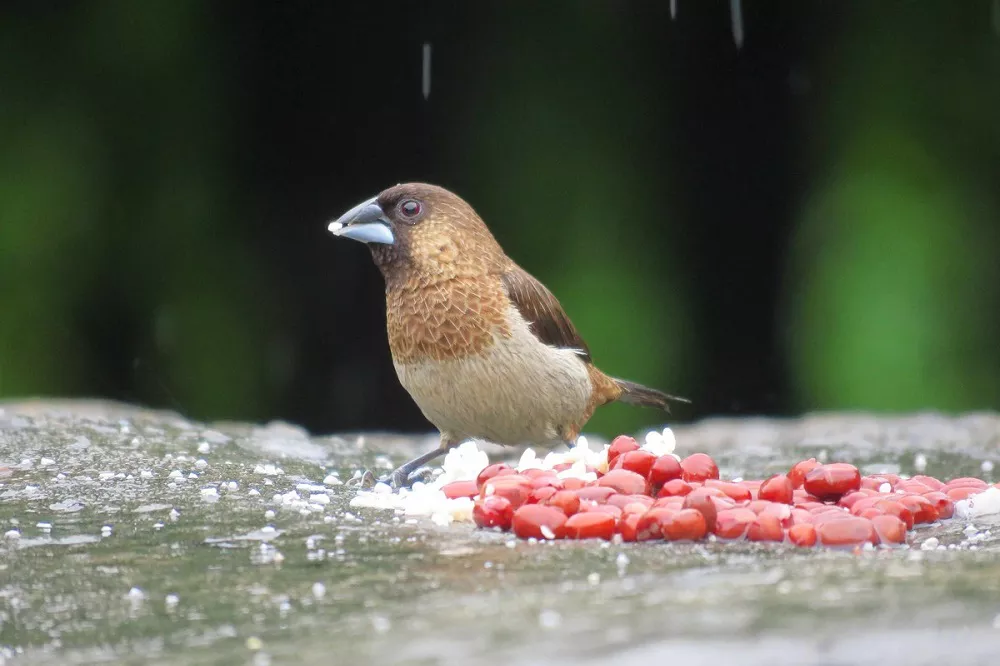
The Scaly-breasted Munia mainly eats seeds.
- Grass seeds
- Rice grains
- Millet and small grains
Additional Food Sources
- Small insects (especially during breeding season)
- Sprouting seeds
Feeding Behavior
They often forage in groups. They use their strong beaks to crack seeds efficiently.
Breeding and Reproduction
Breeding Season
- Tropical regions: year-round
- Temperate regions: mainly spring and summer
Nest Construction
- Shape: Round or dome-shaped
- Materials: Grass, leaves, feathers
- Location: Bushes, trees, or man-made structures
Eggs and Chicks
- Clutch size: 4–8 eggs
- Incubation: 12–14 days
- Fledging: Around 3 weeks
Both parents share responsibilities for feeding and protecting the chicks.
Lifespan and Survival
In the Wild
Most individuals live around 5–7 years. Survival depends on food availability and predators.
In Captivity
With proper care, they can live up to 10 years. Clean environment and balanced diet are important.
Predators and Threats
Natural Predators
- Birds of prey
- Snakes
- Small mammals
Human Impact
- Habitat loss
- Agricultural pesticides
However, the species remains stable due to its adaptability.
Conservation Status
The Scaly-breasted Munia is listed as Least Concern. It has a very large range, and its population is considered stable.
Even so, local threats exist. Habitat loss, trapping for the bird trade, and capture for life-release rituals can affect some populations.
Conclusion
The Scaly-breasted Munia is a resilient and adaptable bird species. Its unique appearance and social nature make it easy to recognize and enjoyable to observe. Whether in the wild or in captivity, it continues to thrive across many regions of the world.
Frequently Asked Questions (FAQ)
Do Scaly-breasted Munias migrate?
They do not migrate long distances. They may move locally in search of food.
Is scaly-breasted Munia rare?
The Scaly-breasted Munia is not considered rare and is widespread throughout its range. It is adaptable to various habitats, including grasslands, rice fields, agricultural areas, and gardens.
Are Scaly-Breasted Munias kept as pets?
Yes, They are kept as pets in some countries. However, always check local laws and ethical guidelines.
Can they live alone?
They prefer company. Keeping them in pairs or groups is better.
What do they eat in captivity?
A mix of millet, seeds, and occasional greens or insects.
 Facebook
  Instagram
  Youtube
 English
  Spanish