
Birdwatchers across East and Southeast Asia often encounter two of the region’s most colorful ground-dwelling birds: the Fairy Pitta and the Blue-winged Pitta. At first glance, these stunning pittas appear remarkably similar. Both display vibrant plumage, inhabit forested environments, and are known for their secretive behavior. However, despite belonging to the same family, they differ in appearance, distribution, habitat preferences, migration patterns, vocalizations, and conservation status.
In this guide, we’ll compare the Fairy Pitta and Blue-winged Pitta side by side, helping bird lovers identify them with confidence.
Fairy Pitta vs Blue-winged Pitta: Quick Comparison
| Feature | Fairy Pitta | Blue-winged Pitta |
|---|---|---|
| Scientific Name | Pitta nympha | Pitta moluccensis |
| Family | Pittidae | Pittidae |
| Length | 16–18 cm | 18–20 cm |
| Weight | 70–110 g | 80–120 g |
| Conservation Status | Vulnerable | Least Concern |
| Main Range | East Asia | Southeast Asia |
| Migration | Strongly migratory | Partially migratory |
| Crown Color | Black with buff stripe | Brownish-buff |
| Underparts | Buff to yellowish | Bright buff-orange |
| Wings | Green with blue highlights | Bright turquoise-blue |
| Habitat | Deciduous and mixed forests | Mangroves, forests, parks |
What Is a Fairy Pitta?
The Fairy Pitta is often regarded as one of Asia’s most beautiful forest birds. Nicknamed the “Eight-Colored Bird” in several Asian countries, it displays a remarkable combination of green, blue, black, buff, white, and red plumage.
This species breeds primarily in East Asia and migrates southward during winter. Due to habitat loss and declining populations, the Fairy Pitta is currently classified as Vulnerable by conservation authorities.
Key Characteristics
- Compact body with short tail
- Distinct black crown
- Buff-colored supercilium (eyebrow stripe)
- Emerald-green upperparts
- Bright blue wing patches
- Crimson-red vent and undertail coverts
- Strong pink legs
The Fairy Pitta spends much of its time foraging quietly on the forest floor, making sightings relatively uncommon despite its striking appearance.
What Is a Blue-winged Pitta?
The Blue-winged Pitta is one of the most widespread and recognizable pittas in Southeast Asia. It inhabits a broad range of environments, including mangrove forests, secondary woodlands, plantations, gardens, and urban green spaces.
Compared with the Fairy Pitta, it adapts more easily to human-modified habitats and maintains a larger, more stable population.
Key Characteristics
- Larger body size
- Bright turquoise-blue wing panels
- Warm buff-orange underparts
- Black facial mask
- White throat
- Green back
- Red vent
Its vivid coloration and frequent vocalizations during breeding season make it one of the easier pittas to observe.
Appearance Differences
Fairy Pitta Identification
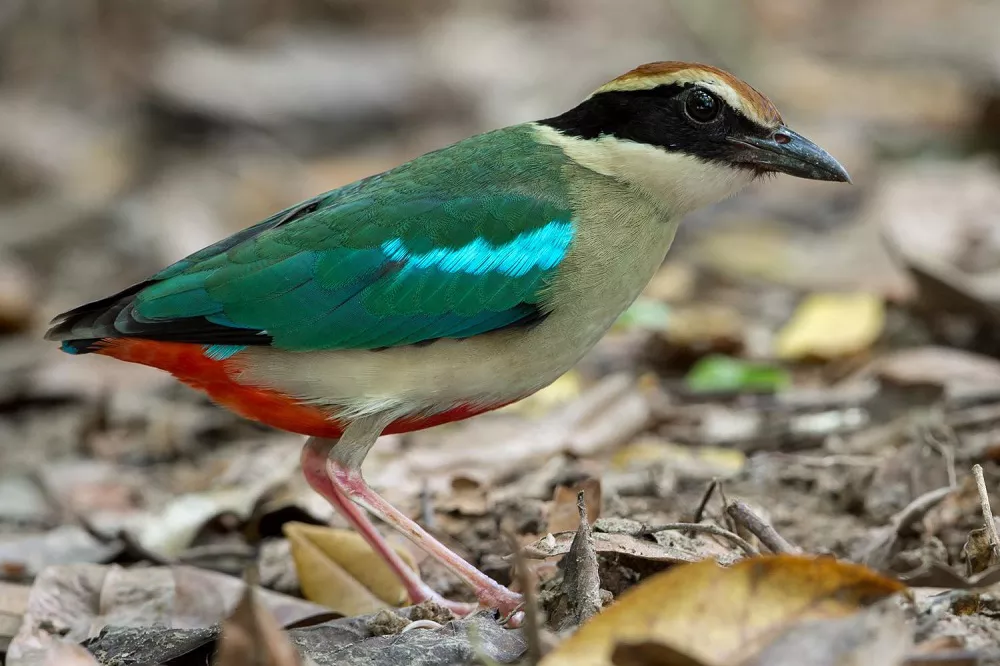
Fairy Pitta
The Fairy Pitta exhibits one of the most complex color patterns among Asian birds.
- Notable Features
- Black crown
- Wide buff eyebrow stripe
- White throat
- Green back
- Blue shoulder patch
- Buff chest and belly
- Red undertail area
The contrast between the black head and buff facial markings is one of the easiest field marks for identification.
Overall Impression
The Fairy Pitta appears more intricately patterned and slightly more delicate than the Blue-winged Pitta.
Blue-winged Pitta Identification
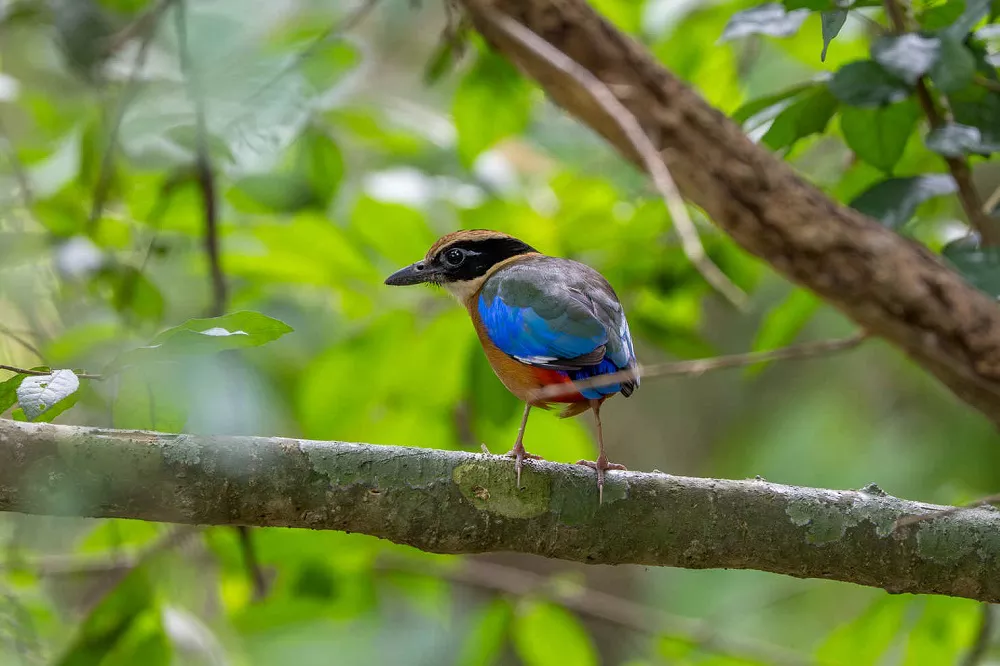
Blue-winged Pitta on the branch
The Blue-winged Pitta presents a cleaner and bolder appearance.
- Notable Features
- Brownish-buff crown
- Black eye stripe
- White throat
- Bright blue wings
- Green mantle
- Orange-buff underparts
- Red vent
Its electric-blue wing panels are often visible even when perched in dim forest conditions.
Overall Impression
The Blue-winged Pitta looks brighter, larger, and less complex in coloration than the Fairy Pitta.
Size and Physical Differences
Although both species are relatively small birds, the Blue-winged Pitta tends to be larger.
Fairy Pitta
- Length: 16–18 cm
- Weight: 70–110 g
- More compact appearance
Blue-winged Pitta
- Length: 18–20 cm
- Weight: 80–120 g
- Slightly heavier build
When viewed side by side, the Blue-winged Pitta appears bulkier with proportionally larger wings.
Geographic Distribution
Where Does the Fairy Pitta Live?
The Fairy Pitta has a relatively restricted breeding range in East Asia.
- Breeding Areas
- South Korea
- Japan
- Eastern China
- Taiwan
- Wintering Areas
- Philippines
- Borneo
- Parts of Southeast Asia
Its migratory journey can exceed several thousand kilometers annually.
Where Does the Blue-winged Pitta Live?
The Blue-winged Pitta occupies a much larger range across tropical Asia.
- Common Countries
- Thailand
- Malaysia
- Singapore
- Indonesia
- Vietnam
- Cambodia
- Myanmar
- Southern China
Some populations migrate seasonally, while others remain resident year-round.
Habitat Preferences
Habitat choice is one of the most useful ways to distinguish these species.
Fairy Pitta Habitat
The Fairy Pitta prefers mature forests with dense understory vegetation.
Typical habitats include:
- Deciduous forests
- Mixed broadleaf forests
- Mountain foothill forests
- Shaded woodland ravines
It generally avoids highly urbanized environments.
Blue-winged Pitta Habitat
The Blue-winged Pitta is far more adaptable.
Common habitats include:
- Mangrove forests
- Secondary forests
- Forest edges
- Plantations
- Urban parks
- Botanical gardens
This flexibility contributes to its wider distribution and healthier population.
Behavior and Feeding
Both species share many behaviors typical of pittas.
Fairy Pitta Behavior
The Fairy Pitta is notoriously shy.
Common behaviors include:
- Solitary foraging
- Ground feeding
- Leaf litter scratching
- Secretive movement through dense vegetation
Its diet consists mainly of:
- Earthworms
- Beetles
- Ants
- Spiders
- Small snails
Blue-winged Pitta Behavior
The Blue-winged Pitta is generally easier to observe.
Common behaviors include:
- Frequent vocal displays
- Open-ground foraging
- Short flights between perches
- Territorial singing
Its diet includes:
- Insects
- Earthworms
- Crickets
- Caterpillars
- Small invertebrates
Both species rely heavily on healthy forest-floor ecosystems.
Vocalizations
Birdwatchers often identify pittas by sound before seeing them.
Fairy Pitta Call
The Fairy Pitta produces a clear, flute-like whistle often described as:
“Pee-yo”
The call is repeated at regular intervals during the breeding season.
Sound Characteristics
- Soft but penetrating
- Melodic
- Often heard at dawn
Blue-winged Pitta Call
The Blue-winged Pitta has a louder and more repetitive whistle.
Sound Characteristics
- Stronger projection
- Repeated sequences
- More frequent calling
During breeding periods, individuals may vocalize continuously from exposed perches.
Migration Differences
Fairy Pitta Migration
The Fairy Pitta is a long-distance migrant.
Each year it travels between:
- East Asian breeding grounds
- Southeast Asian wintering grounds
Migration typically occurs:
- Spring: April–May
- Autumn: September–October
Blue-winged Pitta Migration
Migration patterns vary by region.
Some populations:
- Remain resident
- Undertake short-distance movements
- Shift seasonally based on rainfall and food availability
Overall, the Blue-winged Pitta is less dependent on long-distance migration.
Breeding and Nesting
Fairy Pitta Nesting
The Fairy Pitta builds a dome-shaped nest using:
- Twigs
- Moss
- Leaves
- Rootlets
Typical clutch size:
- 4–6 eggs
Both parents participate in incubation and chick care.
Blue-winged Pitta Nesting
Blue-winged Pittas construct similar domed nests.
Preferred nest locations:
- Low shrubs
- Forest floor vegetation
- Mangrove thickets
Typical clutch size:
- 3–5 eggs
Parental duties are shared between both adults.
Conservation Status
Fairy Pitta Conservation
The Fairy Pitta faces several conservation challenges.
- Major Threats
- Deforestation
- Habitat fragmentation
- Urban development
- Illegal trapping
Because of these pressures, the species is listed as Vulnerable.
Conservation programs in Japan, South Korea, Taiwan, and China focus on protecting breeding habitats and migration corridors.
Blue-winged Pitta Conservation
The Blue-winged Pitta remains relatively secure.
- Current Status
- Large geographic range
- Stable population trends
- Good adaptability
However, local populations can still be affected by:
- Wetland destruction
- Mangrove loss
- Forest clearing
The species is currently categorized as Least Concern.
How to Tell Fairy Pitta and Blue-winged Pitta Apart
If you encounter a colorful pitta in Asia, look for these key field marks.
Choose Fairy Pitta If You See:
✓ Black crown
✓ Broad buff eyebrow stripe
✓ More complex facial pattern
✓ Forest interior habitat
✓ East Asian breeding range
✓ Smaller body size
Choose Blue-winged Pitta If You See:
✓ Brownish-buff crown
✓ Bright turquoise wings
✓ Bold black face mask
✓ Orange-buff underparts
✓ Mangrove or secondary forest habitat
✓ Larger body size
Conclusion
When comparing the Fairy Pitta vs Blue-winged Pitta, the differences become clear once you examine their plumage, distribution, habitat, and behavior. The Fairy Pitta is a vulnerable migratory forest specialist found mainly in East Asia, while the Blue-winged Pitta is a more widespread and adaptable resident of Southeast Asia.
 Facebook
  Instagram
  Youtube
 English
  Spanish