
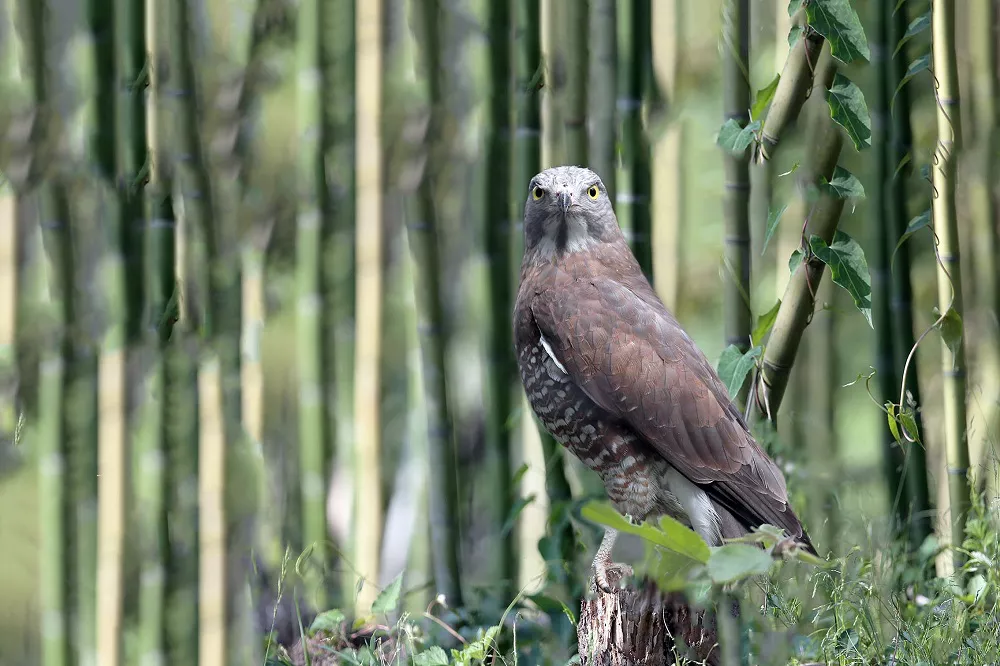
Shikra (Tachyspiza badius) and Besra (Tachyspiza virgata) are two small birds of prey from the Accipitridae family. They look very similar but have key differences in size, looks, habitat, and behavior that help birdwatchers tell them apart.
In this article, we delve into the disparities between the shikra and the besra, shedding light on their physical characteristics, geographic distribution, and ecological preferences.
Introduction to Shikra and Besra
Shikra and Besra belong to the genus Tachyspiza, which includes fast-flying hawks adapted for quick turns in wooded areas. Both birds hunt small prey using surprise attacks from perches. People often confuse them due to shared traits like short wings and long tails. These raptors play key roles in controlling rodent and bird populations in their habitats. Understanding their differences aids conservation and bird identification.
Taxonomy and Scientific Classification
The Shikra’s scientific name is Tachyspiza badius, first described in 1788 by Johann Friedrich Gmelin. It has six subspecies across Africa and Asia, such as T. b. sphenura in West Africa and T. b. badia in Sri Lanka. African forms might be a separate species, but they are currently subspecies.
The Besra is Tachyspiza virgata, described in 1822 by Coenraad Jacob Temminck from Java. It has ten subspecies, including T. v. besra in south India and T. v. virgata in Java and Bali. Both were moved to Tachyspiza in 2024 after DNA studies split the old Accipiter genus. The name “Tachyspiza” means “fast hawk” in Greek.
Physical Characteristics
Shikras measure 26-30 cm long with short rounded wings and a somewhat long tail. Adults have grey upperparts and whitish underparts with fine rufous bars; thighs are whitish. Males show a red iris, females a yellowish-orange one; females are slightly larger and browner above. The tail has faint bands on sides and a dark tip; central feathers lack bands except the tip. Juveniles have streaks on the breast and narrow tail bands.
Besras are slightly larger at 29-36 cm, also with short broad wings and long tail for dense forest flight. They appear as a darker Shikra version with dark blue-grey (male) or brown (female) upperparts, white underparts barred reddish-brown, and thin long legs. All plumages show 3-4 equal dark tail bands. The underwing is strongly barred, and they have a broader gular (throat) stripe.
Key Identification Features
Size differs slightly: Shikras average smaller (26-30 cm) than Besras (29-36 cm). Plumage sets them apart—Shikras have rufous barring and unmarked thighs; Besras are darker overall with bolder streaking on breast and barring below.
Tail shape is crucial: Shikras have a square, shorter tail; Besras a longer, rounded one for better aerial agility. Eye details include Shikra’s grey orbital ring vs. Besra’s yellow; Besra has thinner legs, smaller beak, and blood-red eyes in adults. Underwing primary bars are thicker and more equal in Besra; Shikra’s narrower. Flight shows Shikra’s light underwing coverts and black tips.
| Feature | Shikra | Besra |
|---|---|---|
| Size | 26–30 cm | 29–36 cm |
| Upperparts | Grey | Darker blue-grey/brown |
| Underparts | Fine rufous bars, whitish thighs | Bolder reddish bars, gular stripe |
| Tail | Square, faint side bands | Rounded, 3–4 equal bands |
| Legs/Beak | Thicker legs | Thinner legs, smaller beak |
| Orbital Ring | Grey | Yellow |
Habitat Preferences
Shikras thrive in varied open habitats like forests, farmland, urban areas, savannas, and near villages. They adapt to deciduous forests, groves, gardens, and cultivation up to 1,400 m in Himalayas. Found from sub-Saharan Africa to Southeast Asia.
Besras prefer dense forests, including deciduous, evergreen, and montane woods; less common in open or urban spots. They range across Indian subcontinent, Southeast Asia, East Asia, including Andamans and Philippines. In winter, they may enter savannahs but stick to thick cover.
Geographic Distribution
Shikra’s wide range spans sub-Saharan Africa (e.g., Botswana to South Africa), Indian subcontinent, Middle East, Southeast Asia, and Sri Lanka. Some subspecies migrate, like west African T. b. sphenura; Asian ones are mostly resident except T. b. cenchroides.
Besra distribution is more eastern-focused: Indian subcontinent (Himalayas to Sri Lanka), Southeast Asia (Myanmar, Indonesia), East Asia, Taiwan, Philippines. Subspecies vary by island/mountain, e.g., T. v. rufotibialis in Borneo. No African presence.
Behavior and Hunting
Both use “flap-flap-glide” flight and still-hunting from perches. Shikras hunt lizards, rodents, squirrels, small birds, reptiles, insects, bats, and termites; they even eat carrion rarely. They dive through foliage or ground-hunt.
Besras rely on surprise in dense cover for lizards, dragonflies, small birds, mammals, reptiles, frogs, insects. Their rounded tail aids mid-air captures better than Shikra’s. Besras flick over bushes; both alarm small birds and squirrels.
Vocalizations
Shikra calls are sharp: “pee-wee” (high first note, longer second), or short “kik-ki” in flight. Drongos mimic them to steal food.
Besra calls are softer: “ghee-ghee-ghee” or “pee-pee-pee.” Parents use varied calls during breeding for communication.
Breeding and Reproduction
Shikras breed March-June in India; nest is a twig platform like crows’, lined with grass, sometimes using wires. Clutch: 3-4 pale bluish-grey eggs stippled black; incubation 18-21 days. Both parents build and incubate.
Besras breed variably (March-June north India); new tree nest yearly, 2-5 eggs. Both parents feed chicks; vocal exchanges during deliveries. Nests in dense forests.
Conservation Status
Both species are IUCN Least Concern due to wide ranges and adaptability. Habitat loss threatens forest-dependent Besra more than urban-tolerant Shikra. No major threats reported, but monitoring subspecies is key.
Cultural Significance
In India and Pakistan, Shikra (called “shikra” meaning hunter) is prized in falconry for training ease and hunting crows, partridges. Poet Shiv Kumar Batalvi referenced it in poetry. Besra name derives from Hindi “besrā” for female; less noted in falconry.
Conclusion
Shikra and Besra share hawk traits but differ in darkness, tail, legs, and habitat choice. Field tips: Check tail bands, leg thickness, orbital ring. These distinctions matter for accurate ID, research, and eco-tourism.
 Facebook
  Instagram
  Youtube
 English
  Spanish