
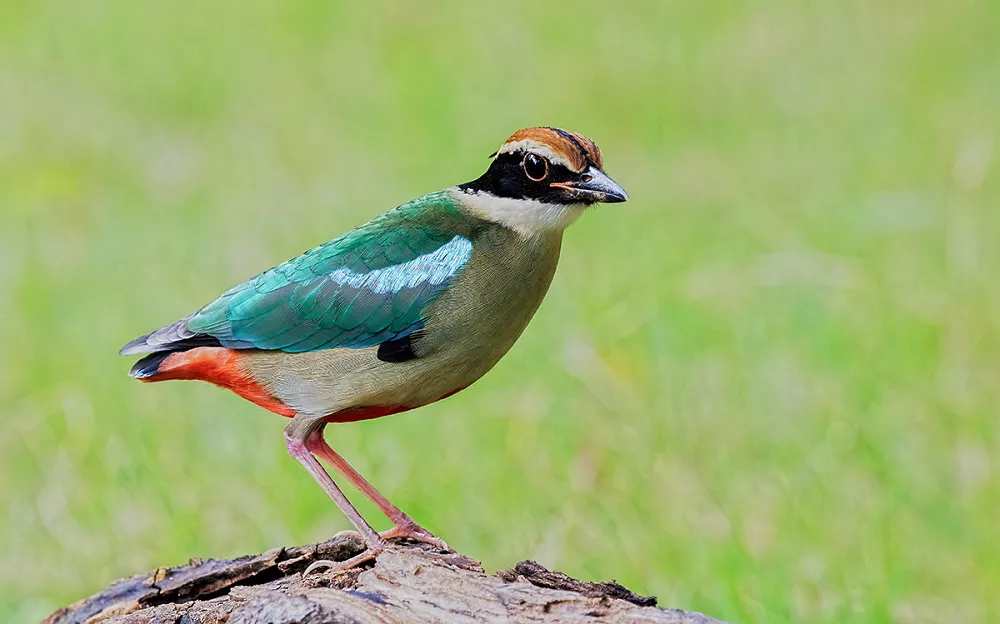
The Fairy Pitta (Pitta nympha) is one of the most beautiful birds in East Asia. Birdwatchers often call it the “eight-colored bird” because of its bright plumage. This small forest bird has vivid green wings, a blue tail, a buff belly, and a black mask across the face. It looks almost unreal when seen in sunlight.
The Fairy Pitta belongs to the pittas, a family of ground-dwelling birds known for their bright colors and shy behavior. Although the species is stunning, it is also difficult to find in the wild. The bird spends much of its time hidden in dense forests. It moves quietly across the forest floor while searching for insects and earthworms.
This article explores the Fairy Pitta’s scientific classification, physical characteristics, habitat, behavior, breeding habits, and conservation status.
What is Fairy Pitta?
Fairy Pitta belongs to the pitta family and its scientific name is Pitta nympha. It is a compact bird with a short tail and an upright stance. Adult birds are usually about 16–20 cm long. The species breeds mainly in East Asia and migrates south during winter.
Scientific Classification
| Common name | Fairy Pitta |
|---|---|
| Scientific name | Pitta nympha |
| Order | Passeriformes |
| Family | Pittidae |
| Genus | Pitta |
| Size | 16–20 cm in length |
| Weight | 90–110 g |
| Diet | Earthworms, insects, and small snails |
| Habitat | They prefer moist subtropical forests, bamboo groves, and wooded areas. |
| Distribution | Breeds mainly in parts of South Korea, Japan, China; winters in Southeast Asia. |
| Conservation status | Vulnerable (IUCN Red List) |
Physical Description
The Fairy Pitta is often described as a “living jewel” because of its exceptionally colorful feathers.
Size and Weight
- Length: Approximately 16–20 cm (6–8 inches)
- Weight: Around 70–110 grams
Although relatively small, the bird has a compact body, strong legs, and a short tail suited for life on the forest floor.
Plumage and Coloration
The Fairy Pitta displays a remarkable combination of colors:
- Bright green back and wings
- Deep blue wing patches and tail
- Warm buff-colored underparts
- Black head with a pale cream stripe above the eye
- Distinctive red or crimson belly and vent area
Its vivid coloration helps make it one of the most beautiful birds in Asia.
Distinctive Features
Some notable identifying characteristics include:
- Thick, pointed bill for catching insects
- Strong pinkish legs adapted for hopping on the ground
- Rounded wings suitable for short forest flights
- Bold facial markings
Both males and females look similar, although males may appear slightly brighter during the breeding season.
Habitat and Distribution
Fairy Pittas breed in East Asia, including parts of Japan, South Korea, eastern mainland China, and Taiwan, and they winter mainly in Borneo. During migration, it passes through places such as Vietnam, which is especially important for annual passage.
Migration usually occurs:
- Spring migration: April to May
- Autumn migration: September to October
During migration, some individuals appear on islands and coastal forests.
Behavior and Diet
Feeding Habits
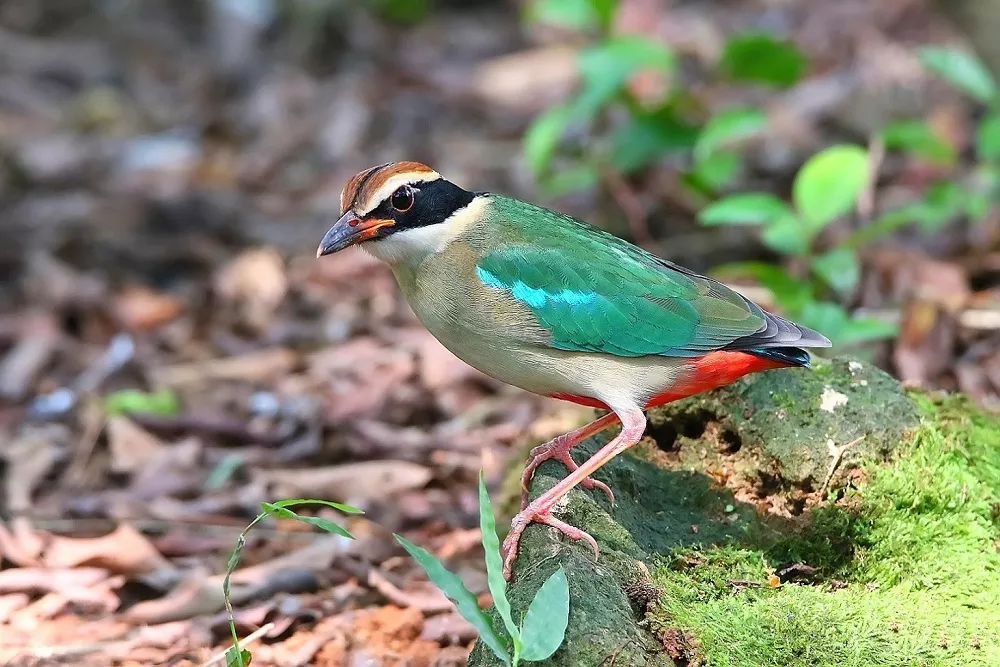
Fairy Pittas spend much of their time on or near the forest floor, where they search leaf litter and soft soil for food. Their diet includes earthworms, beetles, ants, spiders, snails, and other small invertebrates, and they may occasionally take small frogs or lizards.
Social Behavior
Fairy Pittas are generally solitary outside the breeding season. They are shy and secretive, often remaining hidden in dense vegetation. During nest building, they defend their territory and become aggressive towards intruders.
Vocalization
The call of the Fairy Pitta is very distinct. It is a clear, two-note whistle: “kwah-he, kwah-he.” Males call from high branches during the breeding season to mark their territory and attract mates.
Breeding and Life Cycle
Breeding usually occurs from May to July.
The exact timing depends on:
- Climate
- Rainfall
- Local food availability
- Courtship Behavior
Male Fairy Pittas use songs and displays to attract females.
Courtship may involve:
- Wing spreading
- Hopping displays
- Repeated calling
- Feeding behavior
Nesting
The Fairy Pitta builds a dome-shaped nest made from leaves, Twigs, roots, and moss. Nests are usually placed:
- On low tree branches
- In shrubs
- Occasionally near the ground
Eggs and Incubation
Females typically lay 4–6 eggs per breeding season. Both parents participate in incubation, which lasts about 14–16 days.
Chick Development
After hatching, chicks are fed by both parents. Young birds generally fledge within two weeks but continue depending on adults for food and protection for some time afterward.
Conservation Status
The Fairy Pitta is listed as Vulnerable on the IUCN Red List, and its population is believed to be declining. Major threats include deforestation, logging, agricultural expansion, forest fires, and trapping for the cage-bird trade.
Protection efforts include legal safeguards in several countries, such as China, Taiwan, Japan, and both North and South Korea. Conservation work has also highlighted habitat loss from development projects, including concern over the Hushan Dam area in Taiwan, which would affect important breeding habitat.
Conclusion
Fairy Pitta is a rare and highly beautiful forest bird with a long migratory life cycle. It depends on healthy forests in many countries, which makes its conservation important for biodiversity across Asia.
Frequently Asked Questions (FAQ)
Is the Fairy Pitta the same as the Mangrove Pitta?
No. While they look similar, the Mangrove Pitta (Pitta megarhyncha) has a much larger beak and lives exclusively in mangrove forests.
How long do Fairy Pittas live?
In the wild, their lifespan is estimated to be 5 to 8 years.
Where is the best place to see them?
Huben Village in Taiwan and Jeju Island in South Korea are famous “hotspots” for Fairy Pitta sightings during the summer.
 Facebook
  Instagram
  Youtube
 English
  Spanish