
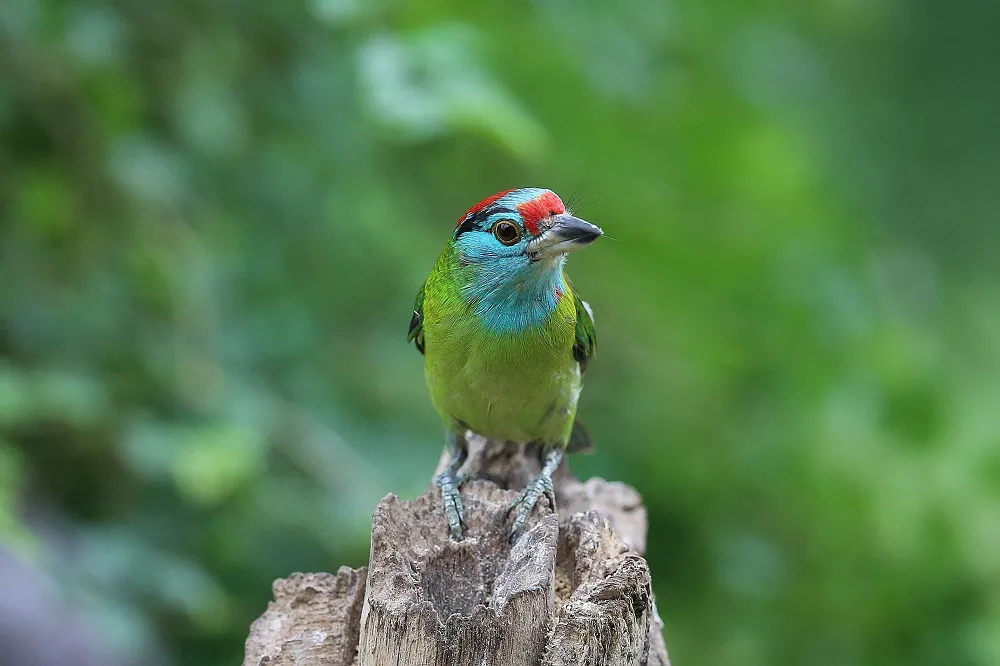
The Blue-Throated Barbet (Psilopogon asiaticus) is one of Asia’s most colorful and recognizable forest birds. Known for its vibrant green body, striking blue throat, red forehead, and loud repetitive calls, this medium-sized barbet is a favorite among birdwatchers throughout South and Southeast Asia.
In this article, you’ll learn everything about the Blue-Throated Barbet, including its identification, habitat, diet, behavior, breeding biology, distribution, and conservation status.
Blue-Throated Barbet Overview
| Feature | Details |
|---|---|
| Common Name | Blue-Throated Barbet |
| Scientific Name | Psilopogon asiaticus |
| Family | Megalaimidae |
| Order | Piciformes |
| Size | 20–23 cm (7.9–9 inches) |
| Weight | 50–90 g |
| Wingspan | Approximately 30–35 cm |
| Lifespan | Estimated 8–12 years in the wild |
| Diet | Fruits, berries, insects, and nectar |
| Habitat | Forests, woodlands, gardens, orchards |
| Distribution | South and Southeast Asia |
| Conservation Status | Least Concern (IUCN) |
What Does a Blue-Throated Barbet Look Like?
The Blue-Throated Barbet belongs to the family Megalaimidae, a group of colorful Asian barbets known for their stout bodies, large heads, and powerful bills.
Key Identification Features
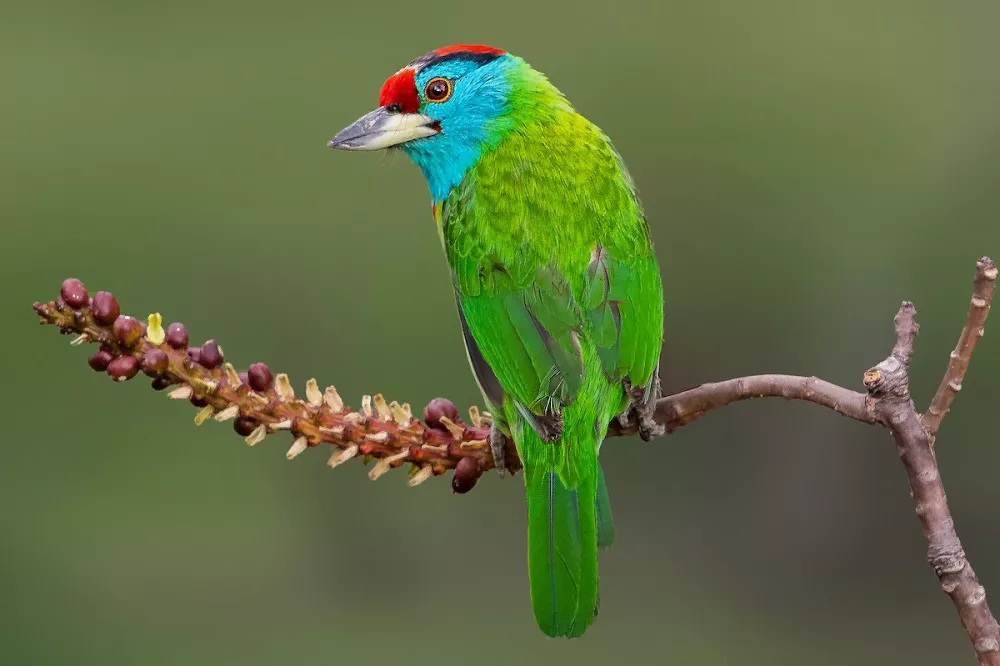
Bright Green Plumage
Most of the bird’s body is covered in vibrant leaf-green feathers. This coloration helps it blend seamlessly into forest canopies.
Blue Face and Throat
Its most recognizable feature is the rich turquoise-blue throat, cheeks, and parts of the face, giving the species its common name.
Red Crown and Forehead
A vivid red patch adorns the forehead and crown, creating a striking contrast with the blue and green plumage.
Yellow Eye Ring
Many individuals display a noticeable yellow orbital ring around the eye, enhancing their colorful appearance.
Thick Barbet Bill
Like other barbets, it possesses a large, stout bill surrounded by bristle-like feathers.
Strong Feet
Its zygodactyl feet (two toes forward and two backward) help it cling to branches and tree trunks.
Blue-Throated Barbet Distribution
The Blue-throated Barbet is widely distributed across Asia and thrives in a variety of wooded environments.
Countries Where It Occurs
The species can be found in:
- India
- Nepal
- Bhutan
- Bangladesh
- Myanmar
- Thailand
- Laos
- Cambodia
- Vietnam
- China
Within India, it is recorded across many northern and northeastern states, and it is especially common in the lower Himalayan region and nearby hill systems. Its range reflects its preference for wooded slopes, forest edges, and fruit-rich habitats.
Habitat of the Blue-Throated Barbet
Blue-Throated Barbets are highly adaptable birds that occupy a variety of wooded habitats.
Natural Habitats
- Evergreen forests
- Deciduous forests
- Riverine woodlands
- Forest edges
- Secondary forests
Human-Modified Habitats
One reason for the species’ success is its adaptability.
Blue-Throated Barbets are frequently observed in:
- Botanical gardens
- Urban parks
- Orchards
- Agricultural landscapes
- Residential areas with mature trees
The presence of fruit-bearing trees is often more important than the habitat type itself.
Blue-Throated Barbet Diet
The blue-throated barbet is mainly a fruit eater. Figs are especially important, and it also takes berries, orchard fruits, buds, and flowers.
It is not strictly frugivorous, however. The species also eats insects and other small invertebrates, including larvae, crickets, mantids, ants, cicadas, dragonflies, locusts, beetles, moths, and even flying termites in some reports.
This mixed diet makes the bird ecologically useful because it helps link fruiting trees with forest food webs. In practice, birders often find it feeding high in the canopy, especially in trees that are currently fruiting.
Blue-Throated Barbet Calls
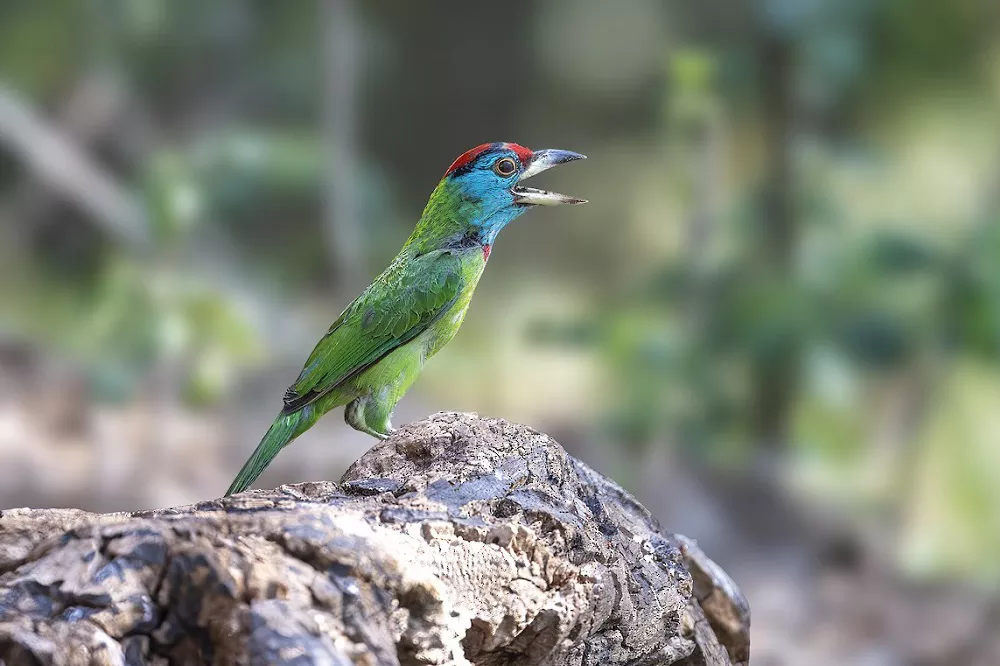
Blue-throated barbets are active and vocal birds. Their repeated calls are one of the best clues to their presence, and vocal activity often increases during the breeding season.
Their calls have been described as repeated notes such as “took-a-rook,” “pu-ku-ruk,” and “kut-ru-uk,” while other reports describe a rapid repeated “tu-tu-tuk” sound. This makes the species easier to detect by ear than by sight in dense foliage.
They are often seen singly, in pairs, or in small groups in the upper canopy. Their behavior is generally calm and deliberate, with short movements between feeding trees rather than long flights across open areas.
Breeding and Nesting
The breeding biology of the Blue-Throated Barbet is particularly fascinating.
Breeding Season
The timing varies depending on location but generally occurs between:
- March and July
Some populations may breed earlier or later based on local climate.
Nest Construction
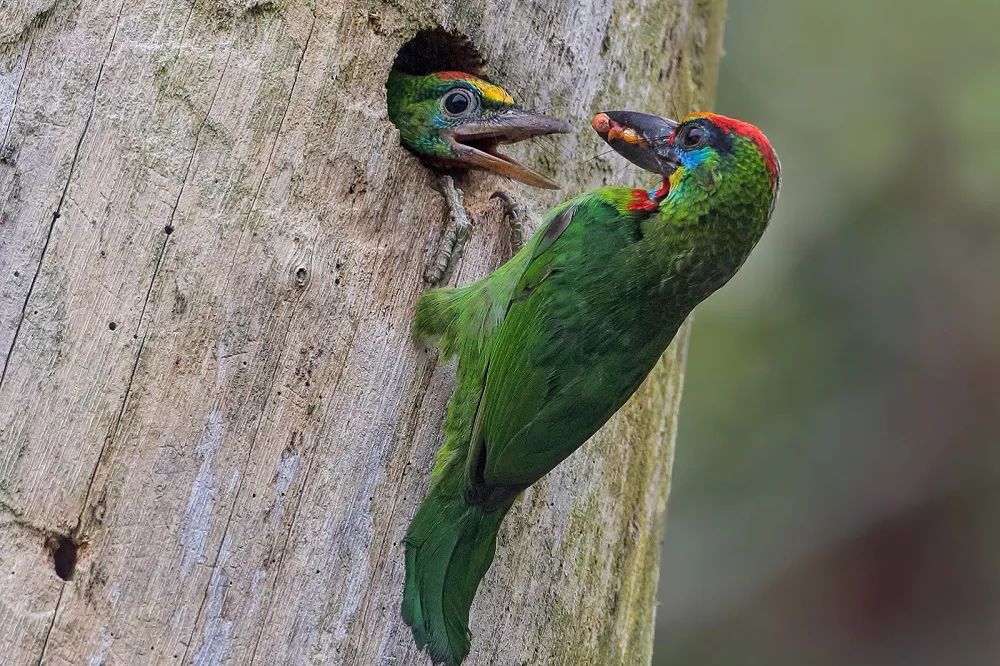
Unlike many songbirds, barbets excavate their own nest cavities.
Nest Sites
Common nesting locations include:
- Dead tree trunks
- Softwood branches
- Decaying trees
Both male and female participate in excavation.
Nest Chamber
The cavity typically contains:
- A narrow entrance hole
- A rounded nesting chamber
- Minimal nesting material
Wood chips often remain on the cavity floor.
Eggs and Incubation
Clutch Size
A clutch typically contains 2-4 white eggs.
Incubation Period
Both parents incubate the eggs, which takes approximately 13–15 days.
Nestling Period
The young birds stay in the nest for approximately 30–40 days.
Parental care continues even after fledging.
Conservation Status
The Blue-throated Barbet is currently classified as Least Concern by global conservation assessments due to its wide distribution and stable population trends.
Even so, the bird can be affected by habitat loss, deforestation, and trapping for the pet trade in some regions. Protecting mixed forests, hill forests, and native fruiting trees is the most effective long-term conservation measure.
Interesting Facts About the Blue-Throated Barbet
- Despite their bright colors, they can be surprisingly difficult to spot among green leaves.
- Their calls may continue for hours during the breeding season.
- They belong to the same order as woodpeckers.
- They excavate nesting cavities using their powerful bills.
- Figs are among their most important food resources.
- They are valuable seed dispersers in tropical ecosystems.
- Males and females look remarkably alike.
- Their colorful facial pattern makes them one of Asia’s most recognizable barbets.
Conclusion
The Blue-Throated Barbet is one of Asia’s most captivating forest birds that combines vivid beauty with ecological importance. Its adaptability, unique vocalizations, and critical role in seed dispersal make it an essential species in Asian forest ecosystems.
Frequently Asked Questions
Is the Blue-Throated Barbet rare?
No. It is considered relatively common throughout much of its range and is classified as Least Concern.
What does a Blue-Throated Barbet eat?
Its diet consists mainly of fruits, berries, figs, insects, and occasionally nectar.
Where can I find a Blue-Throated Barbet?
The species occurs across South and Southeast Asia, especially in forests, woodlands, orchards, and gardens.
Do Blue-Throated Barbets migrate?
Most populations are resident and do not undertake long-distance migrations.
How can I identify a Blue-Throated Barbet?
Look for its green body, blue throat, blue face, red crown, and stout bill. Its repetitive “tuk-tuk-tuk” call is also highly distinctive.
 Facebook
  Instagram
  Youtube
 English
  Spanish