
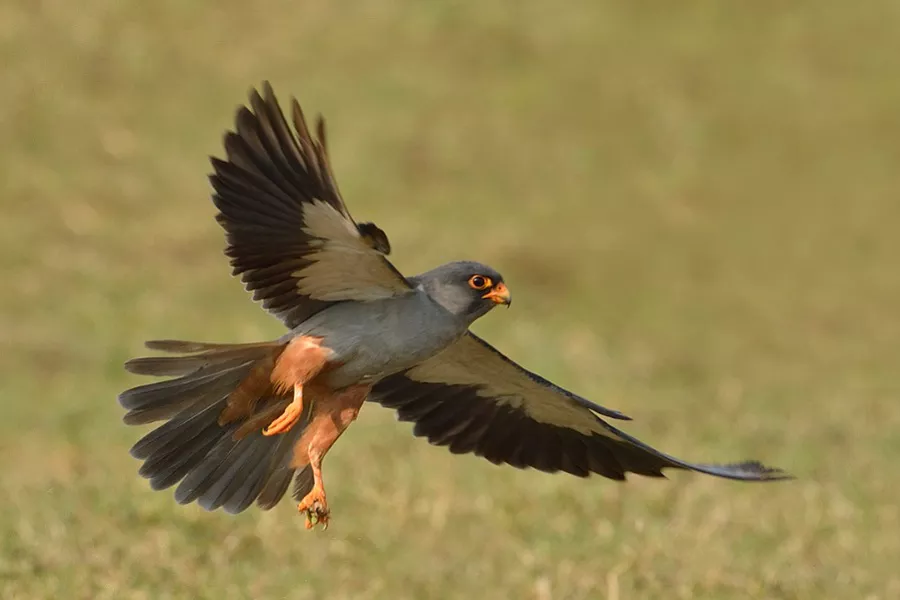
The Amur falcon (Falco amurensis) is a small, long‑distance migratory raptor that feeds mainly on insects, especially during migration and winter. Its diet changes depending on the season, the region it is in, and whether it is feeding itself or raising young.
Overview of the Amur Falcon’s Diet
The Amur Falcon is primarily insectivorous, meaning that insects make up the majority of its diet. However, it is also an opportunistic predator, occasionally feeding on small vertebrates such as birds, rodents, and amphibians.
Main Dietary Categories
- Insects (Primary Food Source)
- Small Birds
- Rodents
- Reptiles and Amphibians
- Occasional Other Invertebrates
This flexible diet allows the Amur Falcon to adapt to different environments throughout its migration.
Primary Food Sources
1. Insects – The Staple Diet
Insects form the backbone of the Amur Falcon’s diet. These are abundant, easy to catch, and rich in protein and fats.
Common Insects Consumed
- Termites: Especially winged alates during swarming seasons.
- Locusts and Grasshoppers: Provide high energy during migration.
- Beetles: Frequently captured in open fields.
- Ants: Consumed when available in large numbers.
- Dragonflies: Often caught in flight.
- Moths and Flying Insects: Taken during aerial hunting.
Why Insects Are Ideal
- High Energy: Essential for long-distance migration.
- Abundance: Easily found in breeding and wintering areas.
- Ease of Capture: Suitable for the falcon’s agile flight.
2. Termites – A Migration Superfood
One of the most important food sources for the Amur Falcon is winged termites. During migration, especially in northeastern India and parts of Africa, massive termite emergences provide an abundant and energy-rich food supply.
Benefits of Termites
- High fat content for energy storage.
- Easy to capture in large numbers.
- Available in predictable seasonal swarms.
This reliance on termite swarms is a key factor in the falcon’s successful migration.
3. Locusts and Grasshoppers
Locusts and grasshoppers are another major component of the Amur Falcon’s diet. These insects are particularly abundant in grassland ecosystems and agricultural areas.
Nutritional Advantages
- Rich in protein.
- Provide sustained energy.
- Often occur in swarms, allowing efficient feeding.
4. Small Vertebrates
Although insects dominate their diet, Amur Falcons occasionally prey on small vertebrates when insects are scarce.
Examples Include
- Small Birds: Such as sparrows or fledglings.
- Rodents: Including mice and voles.
- Lizards and Frogs: Captured in open habitats.
These prey items supplement the diet and provide additional nutrients.
5. Other Invertebrates
In addition to insects, the Amur Falcon may consume:
- Spiders
- Centipedes
- Small crustaceans in wetland areas
These are usually taken opportunistically.
Diet by Region and Season
Breeding areas (Siberia, northern China, parts of East Asia)
In its Siberian–northern‑China breeding range, the Amur falcon uses a mixed diet tailored to chick‑rearing needs. Parents bring back insects, small birds, small mammals, and amphibians to nestlings. This mix ensures chicks receive enough fat, protein, and micronutrients for rapid growth.
Typical prey in the breeding grounds:
- Grasshoppers, beetles, and other large insects from open fields and forest edges
- Small passerine birds snatched on the wing or from low perches
- Rodents and shrews caught near ground level or in light scrub
- Frogs and small lizards from wetland margins or slow‑moving streams
During this period, Amur falcons often choose nesting sites near open landscapes where insect and small‑animal populations are high.
Migration stopovers (India, the Arabian Sea, East Africa)
Along its epic migration route—from Siberia through India and across the Arabian Sea to southern Africa—the Amur falcon relies heavily on insect‑rich stopover sites. In northeastern India, for example, its diet is dominated by termites, which can make up about 80–90% of prey items during certain months.
Why termites are so important:
- Termite swarms erupt after rains and in warm, humid conditions, exactly when Amur falcons pass through regions like Nagaland and Manipur.
- These swarms provide a dense, energy‑rich food source that allows the falcons to rest and refuel quickly before continuing their long flight.
During the Arabian‑Sea crossing, migrating dragonfly swarms are thought to be a key high‑altitude food source, helping the birds survive the most challenging part of the journey.
Nonbreeding (African) winter quarters
In southern Africa, Amur falcons spend several months in large, noisy roosts in open savanna, grassland, and woodland areas. Here, their diet is almost entirely insect‑based, with occasional small vertebrates.
A detailed study of regurgitated pellets in South Africa showed that the falcons fed on animals from seven invertebrate orders and three vertebrate orders, but the vast majority of items were invertebrates. The five most common prey groups were:
- Coleoptera (beetles)
- Orthoptera (grasshoppers and locusts)
- Isoptera (termites)
- Solifugae (camel spiders or “wind scorpions”)
- Hymenoptera (ants and wasps)
Less frequent prey included moths/butterflies (Lepidoptera), true bugs (Hemiptera), small birds (Passeriformes), rodents (Rodentia), and shrew‑like insectivores (Soricomorpha). The exact mix shifts through the season as local prey populations rise and fall after rains.
How the Amur Falcon Hunts for Food
Timing: late evening and early morning.
Amur falcons are most active in feeding during late evening and early morning, taking advantage of insect swarms that emerge after sunset or at dawn. This crepuscular pattern helps them avoid midday heat in tropical and subtropical regions and reduces competition from some diurnal predators.
Open‑air hunters, not just ambushers
Unlike many raptors that rely on silent ambush from trees, Amur falcons are highly aerial and agile. They use two main techniques:
- Hawking insects in flight: The falcon flies into swarms of termites, ants, dragonflies, or grasshoppers, snatching them with its beak or talons while still airborne.
- Hovering and dropping: The bird may hover briefly over open fields or grasslands, then drop to the ground to grab a larger insect or a small vertebrate.
This hovering behavior is especially useful over open habitats where prey is scattered and not easy to spot from a single perch.
Use of man‑made perches
Amur falcons often perch on telephone poles, wires, and fence posts when hunting. These elevated vantage points give them a clear view of the ground and allow them to swoop down quickly on insects and small animals. In agricultural areas, they favor fields where crops or grasses attract grasshoppers and other insects, creating a reliable food source.
Ground‑level feeding
Although they are strong fliers, Amur falcons will also land on the ground to pick up prey. After catching an insect or small animal, they may carry it back to a perch or low branch to eat, which helps them avoid ground predators and manage larger prey more easily.
Why the Amur Falcon’s Diet Matters for Conservation
Link between diet and migration routes
The Amur falcon’s reliance on insect swarms tightly links its survival to specific natural events and landscapes. For example:
- Termite and locust swarms in India and Africa must occur at roughly the same time as the falcons’ migration window.
- Dragonfly migrations over the Arabian Sea provide a moving “in‑flight” food source for the birds.
If climate change, pesticide use, or habitat loss disrupts these insect populations, the falcons may arrive in key areas without enough food, leading to lower survival rates.
Protection of roosting and feeding sites
In several African countries, large communal roosts of Amur falcons attract local attention, and some local communities have set up protection efforts around these sites. Protecting these roosts is important because:
- They provide safe places for the birds to rest and digest large quantities of insects.
- Nearby grasslands and wetlands must remain healthy to support insect populations.
In India, campaigns have also highlighted the Amur falcon’s role as a natural pest‑control species, since its diet includes grasshoppers and locusts that can damage crops. This ecological service strengthens the case for their conservation and can help local communities see them as allies rather than competitors.
Threats related to food scarcity and hunting
Historically, Amur falcons have faced direct hunting pressure in parts of India and Africa, where local people would catch and sell them. When falcons are killed at stopover sites, they lose critical opportunities to feed and rest, which can weaken or even kill individuals before they complete their migration.
Modern conservation programs now focus on:
- Banning hunting and trade of Amur falcons near key stopovers.
- Educating communities about the bird’s insect‑based diet and its usefulness in controlling crop‑eating pests.
- Monitoring prey availability around roosts to ensure insect populations remain healthy.
These efforts help the species meet its energy needs all along its 20,000 km+ round‑trip journey.
Conclusion
The Amur Falcon is a remarkable migratory raptor with a highly specialized and adaptable diet. Insects—particularly termites, locusts, and grasshoppers—form the cornerstone of its nutrition, enabling it to undertake one of the longest migrations in the avian world. While it occasionally consumes small vertebrates, its role as a natural pest controller makes it ecologically invaluable.
 Facebook
  Instagram
  Youtube
 English
  Spanish