
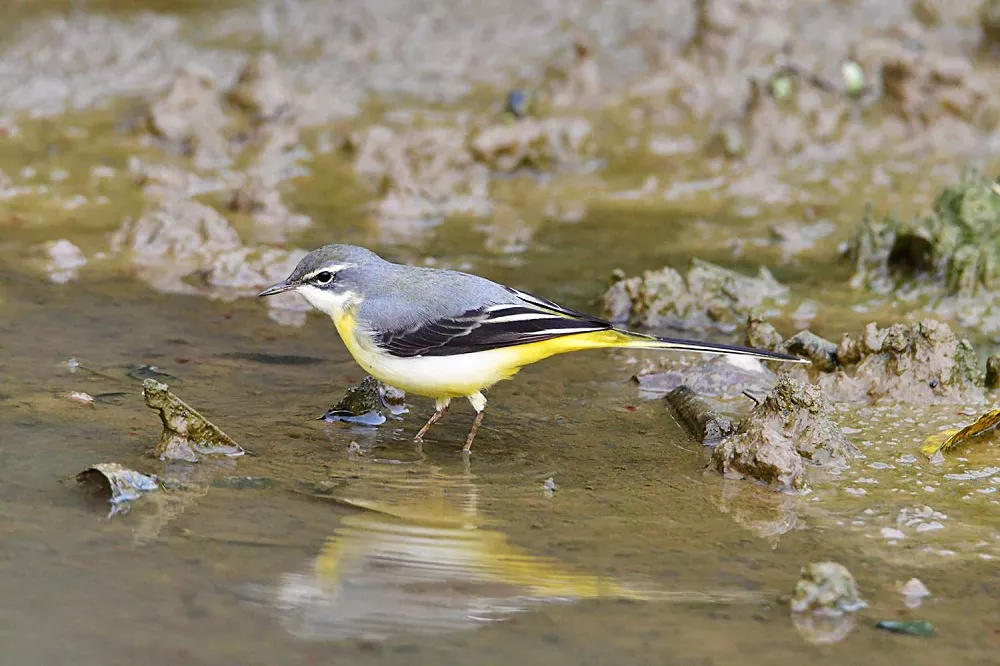
The Grey Wagtail (Motacilla cinerea) is one of the most elegant and fascinating birds you can encounter near fresh water. Often mistaken for its relative, the Yellow Wagtail, due to its bright yellow plumage, the Grey Wagtail is a distinct species with unique behaviors and habitat preferences.
This article provides an in-depth exploration of the Grey Wagtail, covering its identification, habitat, behavior, diet, breeding, migration patterns, conservation status, and its ecological importance.
Introduction to the Grey Wagtail
The Grey Wagtail, with the scientific name Motacilla cinerea, belongs to the wagtail family. It is a slender bird with a very long tail and a quick, lively way of moving. Its name may sound plain, but the bird itself is more colorful than many people expect.
This species is closely linked to running water. You will often see it near streams, rivers, waterfalls, canals, and lakes. It is also known for its constant tail movement, which is one of the easiest ways to notice it in the field.
Scientific Classification
The Grey Wagtail, with the scientific name Motacilla cinerea, belongs to the wagtail family. It is a slender bird with a very long tail and a quick, lively way of moving. Grey Wagtails often inhabit places with fast-flowing water, such as rivers, streams, and waterfalls. Its constant tail-wagging behavior gives the species its common name.
Key Facts
| Feature | Description |
|---|---|
| Scientific Name | Motacilla cinerea |
| Family | Motacillidae |
| Average Length | 17–20 cm |
| Wingspan | 25–27 cm |
| Weight | 14–22 grams |
| Lifespan | Up to 8 years |
| Conservation Status | Least Concern (IUCN) |
| Primary Habitat | Rivers, streams, wetlands |
Identification Features
The Grey Wagtail is easier to identify when you focus on the body shape and color pattern. It is a slim bird with a narrow body, long tail, and fine bill. The upperparts are grey, while the underparts are yellow, especially near the vent.
Adult males in breeding plumage are especially striking. They often have a black throat, a white face pattern, and a strong contrast between grey, black, white, and yellow. Females and non-breeding birds look softer in color, but they still keep the same basic pattern.
Physical Characteristics and Identification
General Appearance
Despite its name, the Grey Wagtail is notable for its bright yellow belly and undertail. The grey coloration is primarily seen on the back and wings.
Male vs. Female
| Feature | Male (Breeding) | Female |
|---|---|---|
| Throat | Black | White or grey |
| Underparts | Bright yellow | Slightly duller yellow |
| Back | Blue-grey | Blue-grey |
| Tail | Long with white edges | Similar |
Juvenile Characteristics
Juveniles appear duller with buff or greyish tones and lack the distinctive black throat seen in breeding males.
Distinctive Features
- Long, constantly wagging tail
- Bright yellow vent and belly
- Slender body and delicate bill
- White supercilium (eyebrow stripe)
Habitat and Range
The Grey Wagtail is strongly tied to water. During the breeding season, it prefers fast-flowing streams, rocky rivers, and places with clean, moving water. It often chooses areas where insects are easy to find and where nesting sites are available in banks, crevices, or man-made structures.
Outside the breeding season, it can appear in more varied places. It may be found around lakes, coasts, wetlands, canals, and even gardens with ponds or streams. In some regions, it moves seasonally from upland breeding areas to lower ground in winter.
This bird’s range is wide. It occurs in much of Europe and Asia, and some populations migrate south when the weather turns cold. In many areas, it is a familiar bird of waterways and riversides.
Behavior and Movement
The Grey Wagtail is a lively bird. It spends much of its time walking quickly on the ground or on rocks near water. It also wags its tail up and down in a repeated motion, which is one reason people remember it so easily.
It is usually seen alone or in pairs. It may perch on stones, low branches, or man-made structures near streams. It often feeds in open spaces where it can keep watch for movement and react fast.
Its flight is light and direct. The bird can move between rocks, stream edges, and perches with ease. Because it stays close to water and keeps moving, it can be challenging to observe for long periods.
Diet and Feeding
The Grey Wagtail mainly eats insects and other small invertebrates. It often feeds on flies, midges, ants, beetles, and mayflies. It may also take small aquatic animals such as tadpoles, snails, crustaceans, and other tiny creatures found near water.
It hunts by searching along stream banks, rocks, shallow water, and wet ground. Its feeding style is active and alert. It moves quickly, pauses, and then snaps up prey with precision.
This diet fits its habitat very well. Fast-moving water attracts many small insects and aquatic life forms, so the bird has a steady food source in the right environment. That is one reason clean waterways matter so much to this species.
Breeding and Nesting
The breeding season is an important part of the Grey Wagtail’s life cycle. It usually nests near water, often in places that are sheltered and hard to see. Natural nesting sites may include rock crevices, bank holes, and ledges, but the bird can also use bridges, walls, and other structures near streams.
The nest is generally built from twigs, grass, moss, and similar materials. It is carefully placed to protect the eggs and young from weather and predators. The female usually handles most of the nest building and incubation.
Breeding males often become more colorful during this time. Their black throat patch is one of the clearest signs of the breeding season. The species’ close link to water continues during nesting, since it depends on nearby insects and safe shelter.
Song and Calls
The Grey Wagtail has a simple but noticeable voice. Its call is sharp and clear, which helps people notice it before they see it. The bird also gives short trills and quick notes during active moments.
Its sound is not loud like that of larger birds, but it is useful for identification. In noisy streamside habitats, the call can carry surprisingly well. Birdwatchers often learn to recognize it as part of the bird’s overall presence.
The voice fits the bird’s active lifestyle. It does not stay still for long, and its calls often come as it moves from rock to rock or from one feeding spot to another.
Conservation Status
The Grey Wagtail is not generally known as a highly threatened species. In many areas, it remains a familiar bird of rivers and streams. Some populations have even expanded into new places, especially where suitable water habitats are available.
Conclusion
The Grey Wagtail is a small bird with a strong personality. It is active, elegant, and closely connected to water. Its grey and yellow plumage, long tail, and lively behavior make it one of the most distinctive birds near streams and rivers.
 Facebook
  Instagram
  Youtube
 English
  Spanish