

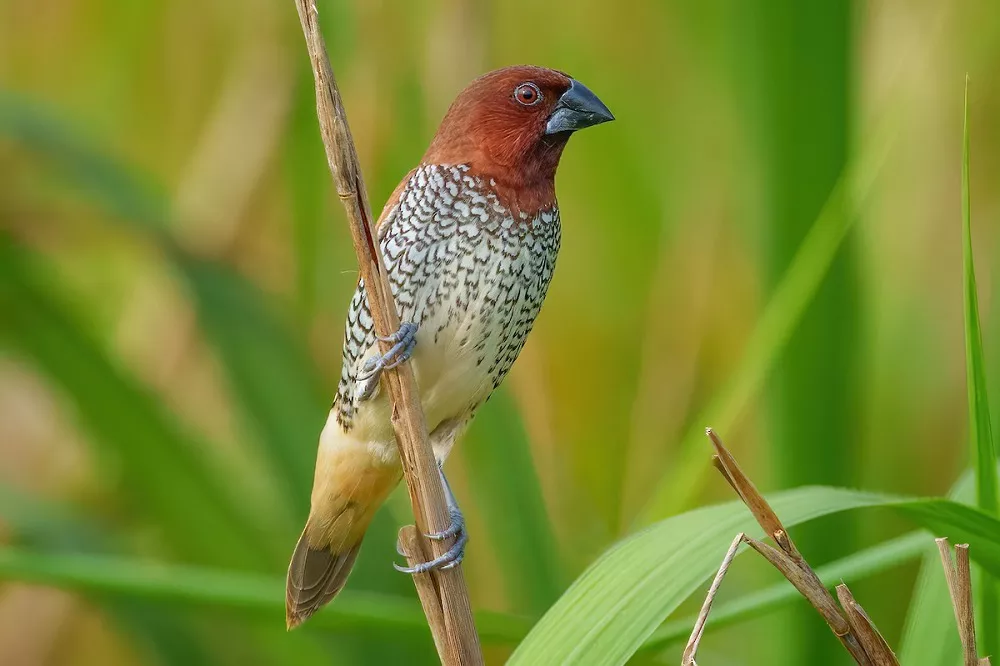
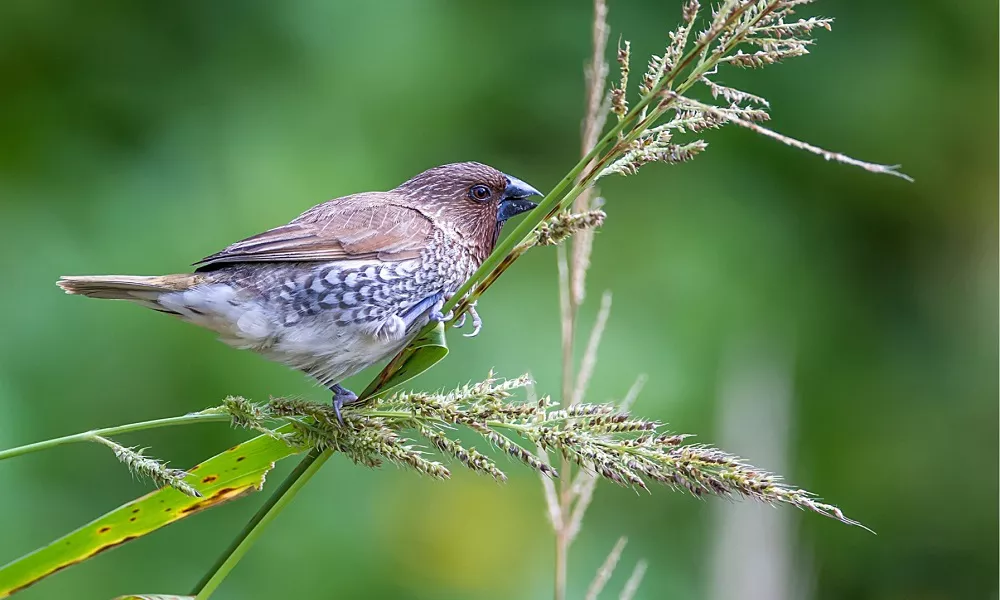
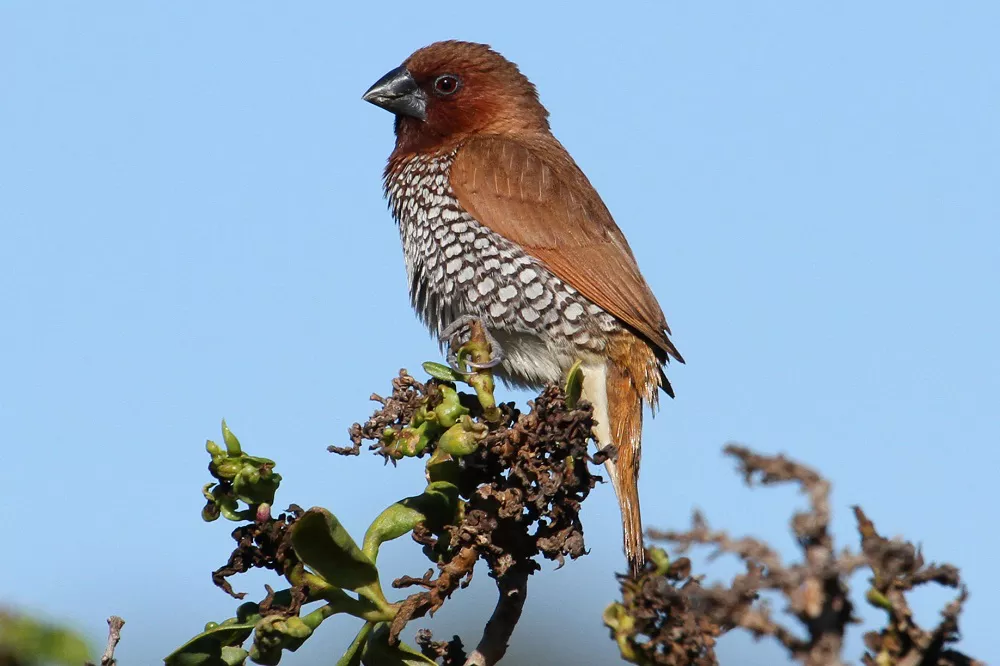
The Scaly-breasted Munia (Lonchura punctulata) is a small, social songbird widely distributed across South and Southeast Asia. Recognized by its distinctive black-and-white scaled breast and brown upperparts, this adaptable bird inhabits a variety of environments, from open grasslands and rice fields to gardens, parks, and urban areas.
Although native to Asia, the Scaly-breasted Munia has also established populations in several regions outside its original range, including parts of North America, the Pacific Islands, and other tropical and subtropical areas.
But where exactly do these birds live? What types of habitats do they prefer, and where can birdwatchers find them?
Let’s explore the geographic distribution and natural habitat of the Scaly-breasted Munia.
Where Are Scaly-breasted Munias Found?
Scaly-breasted Munias are native to South Asia, East Asia, and Southeast Asia. Their natural range extends from Pakistan in the west across the Indian subcontinent and southern China to the Philippines and the Indonesian archipelago in the east.
They occur in numerous countries and regions, including:
- South Asia: Pakistan, India, Nepal, Bhutan, Bangladesh, and Sri Lanka.
- East Asia: Southern and central China, extending northward into parts of central China.
- Southeast Asia: Myanmar, Thailand, Laos, Cambodia, Vietnam, Malaysia, Singapore, Indonesia, and the Philippines.
Their distribution varies among geographic populations and recognized subspecies. In China, for example, they occur widely in the southern and central regions, with records extending north to provinces such as Sichuan, Hubei, and Jiangsu.
Scaly-breasted Munias are generally resident birds throughout much of their native range. Rather than undertaking long-distance seasonal migrations, they tend to remain in suitable local habitats, although their movements can vary with food availability and breeding conditions.
Natural Habitat of Scaly-breasted Munias
Scaly-breasted Munias are highly adaptable birds that prefer open habitats with abundant grass seeds and suitable vegetation. They are commonly associated with agricultural landscapes, grassy areas, and places where seeds are readily available.
Unlike many forest-dependent birds, they do not require dense woodland to survive. Instead, they thrive in open or partially vegetated environments, particularly those influenced by human activities.
Their preferred habitats include the following.
1. Grasslands and Open Fields
Grasslands are among the most important habitats for Scaly-breasted Munias. These environments provide abundant grass seeds, which make up the majority of their diet.
The birds frequently move through tall grasses, using their strong, thick bills to extract seeds directly from grass heads. They often forage in small groups and may gather in larger flocks when food is plentiful.
Open fields with a mixture of grasses and low vegetation offer particularly suitable feeding opportunities.
2. Rice Fields and Agricultural Areas
Rice fields are another important habitat, especially across South and Southeast Asia.
Scaly-breasted Munias readily feed on rice grains and other cultivated seeds. They are often seen in agricultural landscapes, where harvested fields, growing crops, and nearby grassy areas provide reliable food sources.
Their ability to exploit cultivated plants has helped them adapt successfully to agricultural environments. However, large feeding flocks can occasionally cause damage to crops, particularly rice.
3. Gardens, Parks, and Urban Areas
Scaly-breasted Munias have adapted remarkably well to human-modified environments.
They are frequently observed in residential gardens, public parks, golf courses, roadside vegetation, and other urban green spaces. Even in busy cities, these small birds can survive wherever suitable grasses, seeds, and nesting locations are available.
Urban parks and gardens can provide a combination of food, shelter, and vegetation for nesting.
This adaptability also explains why Scaly-breasted Munias have established populations in several regions outside their native range.
4. Shrublands and Woodland Edges
Although they are not primarily forest birds, Scaly-breasted Munias sometimes inhabit woodland edges, scrublands, and areas with scattered trees and shrubs.
These transitional environments offer protective vegetation and suitable locations for nesting and roosting.
They may also use shrubs and trees as resting places between feeding periods.
5. Wetlands and Areas Near Water
Scaly-breasted Munias can also occur around freshwater wetlands, marshy grasslands, and other moist environments.
However, they are not restricted to wetlands and do not depend on permanent water bodies. They are more closely associated with the availability of grass seeds and suitable vegetation.
Scaly-breasted munia
Where Have Scaly-breasted Munias Been Introduced?
Although their natural distribution is centered in Asia, Scaly-breasted Munias have been introduced to numerous locations around the world, primarily through the cage-bird trade and accidental or deliberate releases.
Some introduced populations have successfully established themselves and now breed in the wild.
Important introduced regions include:
- North America: Established populations occur in Hawaii and parts of the continental United States, particularly coastal California, southern Florida, and the Gulf Coast of Texas.
- Pacific Islands: The species has established populations in several Pacific island locations, including Hawaii.
- Australia: Introduced populations have been recorded in parts of Australia.
- Other regions: Established or introduced populations have also been reported in Japan, the Caribbean, Mauritius, and Réunion.
In the United States, Scaly-breasted Munias are particularly noticeable in Southern California, where they can be found in urban parks, grassy fields, and other open habitats.
Why Are Scaly-breasted Munias So Widely Distributed?
Several characteristics have contributed to the Scaly-breasted Munia’s broad geographic distribution and success in different environments.
1. A Flexible Diet
Their diet consists primarily of grass seeds and other small plant seeds. They also consume cultivated grains, including rice. This flexible feeding behavior allows them to exploit food resources in both natural and agricultural environments.
2. Adaptability to Human Environments
Unlike species that depend on specific natural habitats, Scaly-breasted Munias can thrive in gardens, parks, farmland, and other developed landscapes.
3. Social Behavior
These birds are highly social and frequently forage in groups. Outside the breeding season, they may gather in large flocks, helping them locate and exploit food resources across suitable habitats.
4. Successful Breeding
Scaly-breasted Munias can breed throughout much of the year in favorable parts of their native range. Their ability to nest in trees, shrubs, and other suitable locations helps them reproduce in a variety of environments.
Together, these characteristics have enabled the species to occupy a wide range of habitats and establish populations beyond its native distribution.
Are Scaly-breasted Munias Migratory Birds?
Scaly-breasted Munias are generally considered resident birds rather than long-distance migrants.
Most populations remain in their local areas throughout the year, provided food and suitable habitat are available. However, they may make short-distance movements in response to changing food supplies, local weather conditions, and breeding opportunities.
Their highly social nature also means that they can move between feeding and roosting sites in flocks.
Consequently, their local abundance may change throughout the year without necessarily indicating long-distance migration.
Where Can You See Scaly-breasted Munias in the Wild?
If you want to observe Scaly-breasted Munias, look for open grassy areas, agricultural fields, and urban green spaces within their geographic range.
Some particularly promising locations include:
- India and Sri Lanka: Rice fields, grasslands, village surroundings, and public gardens.
- Thailand and Vietnam: Open agricultural landscapes, grassy clearings, and parks.
- Singapore: Urban parks, grass-covered areas, and nature reserves.
- The Philippines and Indonesia: Open fields, cultivated land, and areas with abundant grasses.
- Southern California, USA: Urban green spaces, grassy fields, and suburban parks where introduced populations occur.
These birds are often easier to locate when they gather in flocks. Listen for their high-pitched chirping and watch for small groups feeding among grass stems or on the ground.
Conservation Status of Scaly-breasted Munias
The Scaly-breasted Munia is currently classified as Least Concern (LC) on the IUCN Red List.
Its extensive geographic distribution, adaptability to different habitats, and ability to exploit agricultural and urban environments contribute to its relatively secure conservation status.
However, local populations may still face challenges associated with habitat changes, agricultural practices, and environmental pressures.
It is also worth remembering that an introduced population is not necessarily beneficial to local ecosystems. The ecological effects of introduced populations can vary depending on the region.
Conclusion
Scaly-breasted Munias are widely distributed across South Asia, East Asia, and Southeast Asia, where they inhabit grasslands, rice fields, agricultural landscapes, gardens, and urban parks. Their preference for open habitats and seed-rich environments, combined with their remarkable adaptability, has also allowed them to establish populations in several regions outside their native range.
Whether you encounter them in an Asian rice field or a park in Southern California, these sociable little birds demonstrate how successfully a species can adapt to changing environments.
 Facebook
 Instagram
 Youtube

 English
 Spanish